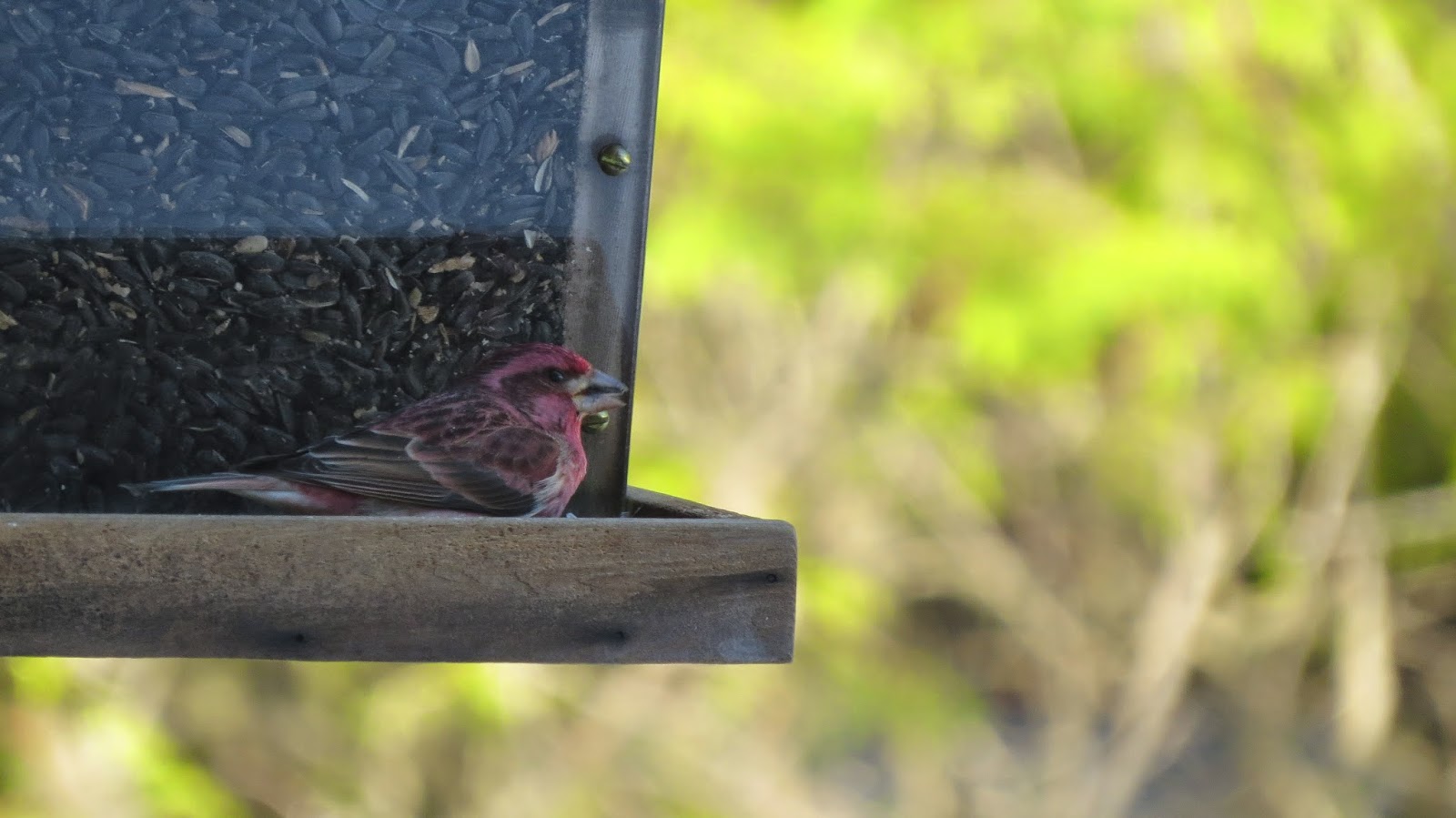
More About Me

Allow me to introduce myself. Most of my spare time is dedicated to natural history and environmental knowledge development and communication. I hold an executive position with the Mississippi Madawaska Land Trust, Carleton, Place, Ontario, Canada. I live in Arnprior, the location of the official tallest tree in Ontario at Gillies Grove. It is a White Pine (Pinus Strobus) with a height of about 47 metres. The National Research Council of Canada has placed me on their Animal Care Committee, which oversees the treatment and care of laboratory animals in human health research. I have my own blog, which captures natural history knowledge and more as I make my way through various eco-districts.

Monday, 14 April 2014

Sap, Syrup and Sun

Monday March 31, Sunny 10 C


One of the warmer days of March; finally the sap flow was excellent today.  I made arrangements with friend, Steve, to help collect the sap at 5 PM. Before that event, we drove to Arnprior, Ontario where our Club,  The Macnamara Field Naturalists' Club, maintains a trail at the Nopiming Game Preserve. This lovely trail begins at McNab St. in Arnprior and wends its way through 4 kilometres of multiple habitats, and also includes a spur which goes down to the Ottawa River at Marshall's Bay.  The Club is planning an extension across the Bay, back to the kiosk at McNab St.  More about the trail and (eventually...keep on returning to find out more) our plans to extend it may be found here:
http://mfnc.ca/macnamaratrail.html

We haven't seen this level of snow pack at the end of March in several decades.  A long cold winter is hard on much wildlife, birds included.  If you begin feeding birds, they become dependent.  So be sure to continue feeding until their natural food sources are once again available.

Here you can see Steve filling the feeders on the trail.  Large flocks of Purple Finches, Goldfinches, Black-capped Chickadees and Woodpeckers (which along with Nuthatches prefer suet over oil seeds or Nyjer seed). Steve has filled these feeders with much more seed than in other recent years.

Chickadee Awaits

Female Hairy Woodpecker takes a break from the nearby suet

We then made our way to the Sugar Maples, where Bob, David and Bruce joined Steve, Joan and me to collect about 35 gallons of sap (which yields about 0.9 gallons of syrup when boiled down). As we entered the maple bush, I noticed a Barred Owl swooping down onto an unseen rodent (unsuccessfully).  You can see the owl checking out movement in the snow, and some seconds afterwards, it swooped down again. Yes Barred Owls will hunt in the afternoon, especially with increased food requirements, as we enter their breeding season.
The team collects sap

Barred Owl ignores us, as a snowbound rodent captures interest

Sap bucket
The sled makes hauling manageable


Steve works and smiles for the camera


Steve collects sap in traditional pails hanging on spiles drilled by hand into maple trees, about 4-5 feet above the ground.  He uses a sled to drag full buckets back to truck he uses to bring the containers to his boiling site.


At Steve's home, many more Purple Finches have been taking advantage of the free food.


After snowshoeing through thick, deep, wet granular snow, the legs can use a few days rest!


A few days later, I visited the Remic Rapids at the Ottawa River. Rapids do not freeze, even in cold winters like this one. So waterfowl and gulls can be found here, as they return from their migration.  The Mallards may not have migrated at all, as more and more of them stay in the open water around city parks where they scrounge for food.
One of the first Canada Geese to arrive at the rapids


A Mallard drake and hen trudge through the snow beside the rapids


Common Goldeneyes only migrate as far south as they need to in order to find open water. Therefore, they usually are found throughout the Great Lakes-St. Lawrence Region during winter, even this winter!  They nest through much of Canada south of the tree line, as they prefer to nest in tree cavities.


I find it amazing how they stay warm feeding in the coldest waters where they catch invertebrates, some small fish and bits of vegetation.

A pair of Goldeneyes in the water, and a Ring-billed Gull on the ice

Migration is on and the Spring ephemeral flowers will be showing soon, so expect more from this blog shortly.


Saturday, 8 March 2014

Mom, I Am Hersty

...for more nature!


Friday, March 7th 2014. A cold (-21C) clear morning transitions into a clear sunny day, south wind, +3C. A good day to go to Lake Ontario, and check out what is migrating on those southerlies.


Amherst Island is one of several islands at the northeastern end of Lake Ontario, accessible by car ferry, at Millhaven, about 30 kms west of Kingston, ON.  It is much larger along its east-west axis than its north-south axis.  It is mostly flat to slightly rolling, and covered by farms. The entire island is a great place to find raptors.


Jon Ruddy and I made the 2.5 hour drive to the ferry terminus, arriving for the 11:30 sailing.  This ferry is a phenomenon in its own right, as it runs all winter, providing permanent residents with a reliable system for going back and forth to the mainland.  To do this, the ferry has a reinforced hull which permits it to respond like a mini icebreaker. 


The channel thus opened during this VERY cold winter, has created a small bit of open water within a very frozen large area of northeastern Lake Ontario,  I have NEVER seen the ice on Lake Ontario stretching so far from the southern shore of Amherst Island. I am told it has happened twice in the last 40 years.


A few Red-breasted Mergansers take advantage of this tiny bit of open water.

Frozen Lake Ontario, and the shoreline of Amherst Island. Note the coyote tracks.


The swirling water behind the Ferry


Note the  broken ice at each side.  Enough ice for a BIG party.


The Ferry dock, Amherst Island


One of the Red-breasted Mergansers-opportunists in the small channel opened up by the Ferry-the ONLY open water for miles around.

Jon and I begin our tour of the island, and immediately spot some Horned Larks at the side of the road. Further on, we find 6 Snow Buntings. We slip-slide to the trail, where we are set upon by a horde of evil chickadees demanding FOOD...NOW!!!


For several hours we tromp around in the snow, meeting two pairs of fellow enthusiasts, one of which tells us that a Barred Owl is nearby.  This turns out to be the ONLY owl we will find, though we spot some hawks in the fields nearby, which alleviates our sorrow and pain to some extent. We both checked myriads of Jack Pines, Cedar, Balsam Fir, Spruce and many hardwood trees up and down, looking for owl profiles and their pellets on the snow.


Jon's View

Jon

Tromping along the tail

Aren't Jack Pines photogenic?


A MOST enthusiastic Barred Owl observes the two humans


We get back to the car, gobble some lunch, adding to our growing number of raptors (4 Rough-legged Hawks and 9 Red-tailed Hawks, one of which is a very different looking northern variety).

We see a Northern Shrike, a large flock of Robins (spring!?) and Snowy Owls, 2 on the Lake Ontario ice and 5 more on various perches.  Yes, a new one day record for me, seven Snowy Owls.


We meet the returning Ferry at 5 PM for the return trip to the mainland.  Next trip, Mexico, New York for the hawk migration.
An ice mound visitor in Lake Ontario

It appears I have been spotted....

The Blogger's shadow at the stern of the Ferry

Jon says BYE BYE to Amherst Island

It appears that the residents don't want windmills!

An island farm seen from Lake Ontario


Saturday, 1 March 2014

Yikes! Shrikes!

Saturday, March 1 2014  -5C Cloudy, Windy, Some snow


Indeed, there are birds that tolerate snow. Some even migrate to our clime to spend the winter.


I offer the previous edition's Lapland Longspur, Horned Larks and Snowy Owls as examples.  Strangely, in my last two outings, I haven't seen any Snow Buntings.  These Arctic birds appear in large flocks along our roads and at our farms during winter.  Have heart though, it appears a few of these intrepid birds have found their way to Florida, with one being reported in Lee County yesterday and two in Duval County today.  Even these very hardy birds have given up this winter!


Today, with the keen eyes of Jon Ruddy, we found not one, but two Northern Shrikes not very far from my residence in Kanata (along March Valley Road, for you local people). I managed to snap a few photos of one.


On January 11 ,and January 26, I snapped photos of these birds' southern cousins in Florida: Loggerhead Shrikes.  It is interesting to compare the two, as it is rare to see both species in such a short timeframe.


Jon also spied a Rough-legged Hawk and a Snowy Owl.


After observing a host of Chickadees,  a Tree Sparrow, a Goldfinch, White-breasted Nuthatches and Mourning doves at the feeders at the west end of the Rifle Range, we then checked out the Deschenes Rapids (Ottawa River) where there were a few Goldeneyes (ducks), Mallards and even a female Bufflehead. Our last stop was the Jack Pine Trail at Moodie Drive...part of our Capital Region's Green Belt.  A nature club maintains some feeders at this trail, where a host of Downy and Hairy Woodpeckers share food with Nuthatches, Chickadees and Mourning Doves.


A few days ago, I went on snowshoes to the same spot accompanied by friends Cathy and Maureen.  We were hoping to see a Black-Backed Woodpecker....a handsome bird of our boreal forest.  We saw signs, but no bird.  To entertain ourselves, we offered some sunflower seeds to the Chickadees, with the following results.

Your Blogger with Chickadee


Downy Woodpecker at Jack Pine Trail feeder (suet)


Friend Maureen on Snowshoes on Jack Pine Trail

Wednesday, 26 February 2014

Of Snow, Education and Owls

Wednesday, February 26, 2014 Sunny, -11C, Windchill -25C


Dear Readers:


I made it back to the Great White North.


The car sojourn from South Carolina to Kanata, Ontario went well, though it was exceedingly dull.


Noted:  I was just ahead (February 11) of another winter storm that paralysed the deep USA south.  The I-95 in North Carolina was receiving a brine mix to ward off icing, as the snow began to fall.  The hills of northwestern Virginia and southern Pennsylvania were covered in deep snow, and the temperature in southern PA, where I spent the night, was down to single digits, Fahrenheit. 


With the Great Lakes 90% frozen, and the weather pattern unchanging, an early Spring seems unlikely.


Some quick daytrips, one on snowshoes on my nature club's lovely trail (The Macnamara Trail in Arnprior, ON) and another just to the west of my home, in the farming community of West Carleton, yielded few birds, and wildlife. Needless to say, botanicals are hard to come by up here in February.


Birds, with the exception of raptors, are few and far between.  Waterfowl have mostly gone further south and to the coast to find open water. That explains the Red-necked Grebes seen off Huntingdon Beach, SC during my visit there.


Yesterday, February 25th, in the afternoon, I went with Jon Ruddy to the North Gower-Stittsville area. This region is dominated by large dairy farms with huge flat fields reminiscent, this time of the year, of the Tundra.  Sure enough, the massive irruption of Snowy Owls into this area was evident. We saw 5 in less than 2 hours. This is a lifetime high for me.

The Snowy Owls haven't been seen in such large numbers in over 50 years.  Researchers have linked their summer 2013 breeding success to a very large population of Lemmings on the Canadian Tundra.  When they are in our region for the winter, their diet broadens from these rodents to many different species of rodents and birds, including ducks and even Great Blue Herons. Snowys are our largest owls by weight.  Whiter owls are older. Most of the owls being seen are darker, as they are juveniles.  Adult females have more darker barring than males. Males, just like humans, get whiter with age.  Therefore, this one may be a middle-aged male, as he still has some light barring on his chest.

Also seen were many American Crows, a large flock of Mallards feeding on corn (which may attract a passing Gyrfalcon in the near future!), one Ruffed Grouse feeding on tree buds, many Red-tailed Hawks, including one with a lot of white on its chest and light colouring overall, and two other winter visitors, a Lapland Longspur with Horned Larks.


Horned Larks


Lapland Longspur

The cold weather keeps we central Canadians indoors more than in warmer seasons. For some of us, this results in much (sometimes too much!) time to think about things. 

As a former classroom educator, and a nature educator, the trend towards urbanization and consumerism has desensitized our society from our natural world.


When I started out in education back in the 70's, I had notions of being an "outdoor education" specialist. This idea quickly went by the wayside, as the entrenched classroom education system became larger and more institutionalized during that period.  Our youth has endured the consequences ever since. The classroom model selects for a very narrow set of qualities, giving youth with those qualities a large advantage during crucial development years.

As in nature, I think diversity is a better model, and I now see the wisdom in efforts to achieve this by conservatives back in the 1970's (charter schools, innovative parent determined funding etc.).  These are inadequate, in my estimation, but, at minimum, if one ignores the ideological biases our politics engenders, they are creative. The outdoor educator can work with new media and create very rich learning experiences for all ages in multiple environments. This could achieve a greater diversity of offerings to multiple learning styles, as every child does learn differently.

I would be most interested in having feedback on this cultural trend towards desensitization.  Horrors...I read today on Facebook some sociologists have LABELED this phenomenon.  Shudders.
More soon.


Wednesday, 12 February 2014

Isn't this Ducky (OR Nothin' Could be FInah than to be in Carolinah)

Sunday, February 9, 2014  Huntingdon Beach State Park South Carolina. Sunny, Breezy, high 50's


This Park, near Myrtle Beach, is a must for the ecologist or ornithologist.  It is located on US 17, just south of Murrell's Inlet.  For $5, you have access to fine trails, lovely beach, and the finest example of a Spartina Salt Marsh I have seen.  My first ecology course at McGill University used a textbook written by Georgia Professor E P Odum, whose research on Spartina salt marshes proved them to be the most biologically productive ecosystems on our continent.  Therefore, visiting such  a fine example does close the circle for me.  Along with Spartina, local volunteers have worked to re-introduce the natural kidneys of the Salt Marsh: Oysters.

Spartina Salt Marsh (Myrtle Beach in background)

Happy Oysters gathered on Pylon

I had a serendipitous moment.  As I searched for birds at the causeway which crosses the marsh, another birder was looking at the birds.  He turned out to be Jack Peachey,  previously a leader of the Carolina Bird Club, and author of the Huntingdon Beach State Park Bird Checklist.  This was Jack's first time out after recovery from an illness, and we shared my scope to see some of the local birds.  The sun did wash out some ducks at the far end of the marsh, and I promised Jack I would check then out and report:
Jack, it was a great delight and honour to meet you.. We saw these Black-bellied plovers together (one starting to get spring colours).  The ducks were mostly Green-Winged Teal, and there were also Coots, some Blue Winged Teal and a Mute Swan.


While with Jack, a Forster's Tern landed after a successful bout of fishing:


I then went to the beach...my last beach before returning to the frozen north.  After observing a pair of Red-necked Grebes, some Herring, Laughing and Ring-billed Gulls, and these Sanderlings,


I took a series of beach photos, ones that are designed to give the feeling of an Atlantic Beach, and its possibilities, sounds, sights, smells:


I then finished my day with a ducky time, after going to the education center, and finding Carolina Chickadees, Cardinals, and this Tufted TItmouse at the feeder, and, the ubiquitous Yellow-rumped Warbler at the bath:


Duck-phasmagoria (pick out the (Jon) Ruddy Duck:

Ruddy Duck

Ring-Necked
Four Species (which one is the Redhead?)
Thanks again, Jack.  We hope to see you adding to the checklist soon!