More About Me

Allow me to introduce myself. Most of my spare time is dedicated to natural history and environmental knowledge development and communication. I hold an executive position with the Mississippi Madawaska Land Trust, Carleton, Place, Ontario, Canada. I live in Arnprior, the location of the official tallest tree in Ontario at Gillies Grove. It is a White Pine (Pinus Strobus) with a height of about 47 metres. The National Research Council of Canada has placed me on their Animal Care Committee, which oversees the treatment and care of laboratory animals in human health research. I have my own blog, which captures natural history knowledge and more as I make my way through various eco-districts.

Monday, 13 January 2014

Rocks that Blow

Sunday, January 12, 2014  A Luscious Day, picture perfect, all sun and high 70's F Jan and I went down to Jupiter Island (yes, the place where that golfer dude and the singing Quebecoise live:  cheap real estate) and visited the NC's Blowing Rocks Preserve, so named due to the high tide phenomenon of waves whacking against the fossil shell encrusted limestone along the shoreline.

Jupiter Island marks the south end of the Indian River Lagoon.  It's location and the juxtaposition of the Florida Current just offshore, give it a sub-tropical climate, with corresponding plant communities.  The geology is also interesting, as this is the only part of the barrier island complex that has emergent limestone (the blowing rocks) on the beach.

The Nature Conservancy has done a great job of removing invasive exotic plants and they are replacing those with native plants, including Red Mangroves along the Indian River Lagoon. One of the salt-tolerant native plants is the Blackbead, Pithecellobium keyense.


This native of South Florida, Mexico, the Caribbean and South America is host to the Large Orange Sulphur Butterfly. As you can see here, the red pod ripens to reveal black seeds. The fleshy red pods are eaten by birds and other animals.

There are many plants in most South Florida habitats which scratch, sting and even poison.  One of the most attractive is Spurge Nettle, Cnidosculus stimulosus.  According to Green Deane, the root of this plant is edible.  He describes how to dig it up without touching the plant.

http://www.eattheweeds.com/spurge-nettle-the-nettle-with-the-mettle/

 You gotta love the poetry, the nettle with the mettle.


As we walked along the Lagoon beach, we noticed the newly planted Red Mangroves, one of several critical Lagoon ecological maintenance plants.  So many organisms are dependent on their cleansing, and safe haven properties. They are highly protected under State law.  And the Nature Conservancy is planting more along their lagoon property.

Just down the beach from these mangroves, I noticed an Osprey with a Mullet which the bird had just captured.


The warm day, and a stop at a local favourite eatery, finished our Florida day on a high note. We were spent and slept well!

Thursday, 9 January 2014

George LeStrange Preserve

January 6, 2014 3 PM Sunny, 80F  Cold Front visible to the Northwest (vestiges of the Polar Vortex!)

St. Lucie County maintains over 20 Preserves with a minimum of staff.  The largest, Bluefield, has over 3,000 acres, and the total acreage is over 7,000 acres.  George LeStrange is a small (94 acres) and diversified preserve, with a good-sized pond, a creek and an interpretive trail:

 
The trail is of ecological and botanical interest. Trees here include the Water Hickory, Carya aquatic and Carolina Ash, Fraxinus caroliniana. The Ten Mile Creek was a classic meandering oxbow stream, and some of the previous oxbows (the creek was "straightened") have filled with plants that like to have their roots in, or close to water (like the hickory and ash).
Water Hickory

Carolina Ash
There are many members of the Aster family found in Florida (and throughout the world!).  They are often difficult to distinguish, except by experts.  For example, I found this aster blooming along the trail. 


I conducted significant online study, including this article:


The 20 or fewer disc florets (what normal people may call petals!!), white-mauve colour and long reddish stems indicate the less common Bahamian Aster.  Only an expert could confirm this!

Some plants along the trail are identified in the trail guide.  Printed trail guides are normally a handy reference. Problems arise because the plants, and plant communities, change constantly. So a plant present during one season and year may be absent when you happen to walk the trail. Also, the trail guide's writer may be an expert, or may not be.  Corroboration is always advised if you need a certain identification.

Epiphytes abound in south Florida. Indeed, plants growing on other plants, especially trees, give south Florida its beloved "tropical" look.

One of my favourites, often seen on Live Oak, Quercus virginiana is the small bromeliad, known as Spanish Moss, Tillandsia usneoides (pictured below) . It is neither "Spanish" nor is it a moss.  It is a flowering plant with no roots.

One reader was interested in the recent posting about a unique Florida fern, many of which are also epiphytic.  As mentioned, there are 120 species of ferns in Florida.  Two are often seen on horizontal limbs of oaks and on Sabal palms. 
 
One is the Golden Polypody, Phlebodium aureum, also called Cabbage Palm Fern (pictured below),  since it is most likely to be seen growing on the old leaf bases, or "boots" which persist on these palms, and which make a convenient anchor for some epiphytes.
 
 
The other is the Resurrection Fern, Pleopeltis polypodioides var. michauxiana. This very cool plant responds to dry conditions by browning, curling and shrinking.  Add just a little water, and it "resurrects" quickly.  Some colonies of these ferns observed this year were in flux, common in winter, when rainfall is less reliable.  I saw colonies where half of the individuals were curled up and others were green and full.
This colony, photographed last year at Orcas Preserve, is lush and green.  There was a lot of rain in that period (November, 2012).
 
The other important trees in the coastal plains of Florida are the oaks.  There are many...Live Oak is a large tree as is the Laurel Oak.  There are many species of small scrub oaks. Myrtle and Chapman Oak are pictured here.  Both don't grow more than 15 feet tall, and can be large producers of acorns, important to many wildlife species, such as the Scrub Jay.
Florida Scrub Jay, Merritt Island NWR
The Chapman Oak has the wavy, thick, drought resistant leaves. The Myrtle Oak also has thick, waxy leaves, but the margins are flat, not wavy.
Chapman Oak, Quercus chapmanii, note the oak gall
 
Myrtle Oak, Quercus Myrtifolia

These scrub oaks and Slash Pine are savanna indictor species.  Interesting fact about the Slash Pine. Its name is derived from the 19th century practice of slashing the bark to collect the resin, which is distilled to produce turpentine. This tree is still used for turpentine production.  Today this is a by product of lumbering.  For an excellent learning experience, if you happen to be in south part of the State of Georgia, visit the Chesser Homestead at the Okefenokee National Wildlife Refuge.


I visited in April 2011, and enjoyed a boat ride on the Suwannee Canal.

 
Chesser Homestead

Way Down upon the Suwannee River (ok Canal) with Albert


Sunday, 5 January 2014

Dodging Raindrops: Some Botany, Ornithology and Climatology

Saturday January 4th Cloudy, Light Rain, 75F 24C

Savannas Preserve State Park

At 3 in the afternoon, I headed out on the Yellow and then the White Trails in this state park.  The cloudy and relatively cool conditions permitted a quick 4 miles walk.  These trails go through the Pine-Oak Savanna bounded by large-scale marshes and swamp.  So, a great diversity of plants are found, including ferns.  Florida is home to over 120 species of ferns, though, sadly, half of these are threatened.

One native wetland fern is the Toothed Midsorus Fern or Swamp Fern, Blechnum serrulatum.

It is very common in the park and quite noticeable. In the USA, it is found only in Florida, and is rare in the panhandle.

The fronds are pinnate, alternate, very slightly toothed.    As suggested by one common name, the sori crowd the middle of the pinnae:


New fronds have an attractive form and colour:


Sunday January 5th Partly Cloudy, Scattered showers, 80F 26C

Breaking with habit, I rose at 5:45 AM to assist with the annual National Audubon Society Christmas Bird Count (CBC) for Martin County, Florida.

I drove out to the appointed  location, meeting Bill, John and Pat at 7:00 AM. The CBC divides a county into zones which are covered by a combination of driving, and walking by a team. Having four good birders on a team increases the chances of spotting and identifying as many birds as possible in the given zone.  Bill, as the experienced leader, took us to a number of places he has previously identified as being "bird rich".  We had great fun, and the day went very fast.

Also I am pleased to report that we did find 60 species of birds, and 2 of these species were "lifers", that is these birds were the first I have identified with certainty ever! This is always thrilling for we bird folk.

Both of my new species were southern warblers: 1.  the Prairie Warbler, Dendroica discolor  This was the second Prairie Warbler of the day.  Bill found both.  The first eluded me. The second, thanks to Bill's quick and sure identification, and John's excellent directions, I was able to see in its full glory with all the male field marks easily seen at eye level.  It was a beautiful sight.

2,  the Yellow-throated Warbler,  Dendroica dominica  I found this one...and what a visual treat. This small beautifully marked warbler is visually stunning. 

We also found Pine Warblers and several White-eyed Vireos. One of the latter, another lovely and striking bird, appeared just in front of us at eye level, giving me the best views of this bird I have ever had.

Thanks to Bill, we were able to go to the home of his friend Bob, who has had Painted Buntings at his feeder,  Bob welcomed us into his well-situated home, and we lucked out.  Two females first appeared, followed by a single male in full regalia.  Look up or Google the Painted Bunting- one of the most colorful birds anywhere.

Thanks Bill, John and Pat for including me in this shared experience.


My New Birder Friends from left John, Pat, Bill Hoping for Species number 60
 
A Rose between 2 Thorns from left Blogger Art, Pat, Bill
Enjoy the night.  I will be dreaming of the birds we saw, and the promise of more to come.

Friday, 3 January 2014

A Mixed Bag of Reminders

Friday January 4, 2014  Cloudy, Windy 62F 16C

A short walk late in the afternoon at Savannas Preserve State Park reminded me of a few things. One, I owe the readers an identification of a nut found on Jensen Beach.  A flower reminded me of a few interesting winter plants you can find in various habitats.

And early in December, just outside the condo property, I saw a bird that is still confusing me.....that, dear reader, is the nature of nature.  It often confuses, and the books don't cover all the variety one can see. A single species may vary far more than one can imagine.

Then, I saw the same bird again today, same area and it reminded me that I need a better camera for long range photos!  Thanks goodness it is coming in a few days.

The bird, by the way, is a hawk.  It has a short tail with bands. it is medium sized, for a North American Hawk.  It has a light belly, a bit of chest bars and a brown mottled pattern on the back. Some candidates: 1. An immature Red-shouldered Hawk with irregular markings  2. A Broad-winged Hawk which ought to be in South America since Mid-November 3. A Short-tailed Hawk, which has been seen locally only once in the past few years. Only 200 pairs are known to be in Florida. Most of these are in the central forested areas from Lake Okeechobee south.  The latter is very unlikely. The first is most likely.  So much for certainty! Hopefully the bird stays around for another week, and I can get a better photo and see it more clearly in my binoculars.

Until then....

some living things I can identify, though it always takes some work!

I found more of these flowers blooming today at Savannas Preserve SP.


This is the Florida Sensitive Flower or Florida Mimosa, mimosa quadrivalvis var. floridana.  This genus, Mimosa, is well known as a cultivated plant due to its unique "sensitivity".  When touched, the leaves close up.  Perhaps a science teacher back in school showed you one, and you were SO impressed!

Ok, I will demonstrate.  A Florida Mimosa before I touched its leaves.


A Florida Mimosa after I touched its leaves. It's magic! Are you able to guess at a competitive advantage provided to the plant?


The nut I found at the beach...


Thanks to Green Deane and the Green Deane Forum for help with this:

http://www.eattheweeds.com/tropical-almond-sea-almond/

The Tropical Almond is a tree used for landscaping in south Florida, and in many other warm coastal places around the world.  It isn't really an almond, but it is an attractive tree that grows in rather intense conditions.  And if you get a chance, do take one of Green Deane's courses....as informative as they are entertaining.  Reminder: don't taste or eat anything in the wild without a certain ID from an expert, like Deane.

Another native flower at Savannas Preserve State Park is Prostrate False Buttonweed, Spermacoce prostrate (it is possible this is another Spermacoce species, as the USDA database does not include this species in St. Lucie County).


Extra bonus!  A Bahamian Paper Wasp, Polistes bahamensis.

Sometimes, a real beauty is small and close to the ground , (and in this case, some of the fruits and flowers are IN the ground!):


Roundleaf Bluet or Innocence, Houstonia procumbens 
 
 
And, especially for Christmas season, a wild version of the Poinsettia is a native plant of south Florida.  As the holiday season comes to an end, the Painted Leaf or Pineland Spurge, Euphorbia pinetorum  still provides a splash of wild colour.

Thursday, 2 January 2014

Two Palm Beach County Jewels

January 2, 2014  Full sun, 85F 30C

Palm Beach County, Florida, is best known for opulence, luxury and the former spring training ground of the Montreal Expos.  Those attributes may describe the cities of Palm Beach and West Palm Beach. The County is much larger than those two places.  It stretches west to the Everglades, Florida's immense wide, slow, shallow river. Most of south Florida's water is derived from the Everglades.  Also, a large area of the Everglades is committed to agriculture, mostly sugarcane.

In pursuit of better water management, the Palm Beach County Water Utilities Department and Park and Recreation Department have collaborated to create two large constructed wetlands and parks: Green Cay and Wakodahatchee. From the Green Cay Website:

"Water Reclamation
In addition to providing educational and recreational opportunities for the public and habitat for wildlife, the Green Cay Wetlands have been designed to naturally filter several million gallons of highly treated water each day from Palm Beach County's Southern Region Water Reclamation Facility. The wetlands also help to recharge groundwater resources and keep water in the earth's water cycle. To accomplish this, Green Cay incorporates 86 different species of trees, shrubs, grasses and aquatic vegetation. "

From the Wakodahatchee Website:

"Every day, the Palm Beach County Water Utilities Department's Southern Region Water Reclaimation Facility pumps approximately two million gallons of highly treated water into the Wakodahatchee Wetlands. By acting as a natural filter for the nutrients that remain, the wetlands work to further clense the water.
Traditional methods for disposal of treated wastewater have included deep injection wells or ocean outfalls. More recent emphasis has been placed on highly treating and reclaiming wastewater. The Palm Beach County Water Utilities Department is a pioneer in the fields of wastewater treatment and reclaimed water distribution for irrigation purposes. The Wakodahatchee Wetlands are yet another example of the Department's innovative and forward-thinking management philosophies."

Canadian municipalities have a lot to learn from this approach to water reclamation and management.

Today, I visited two of the Palm Beach County jewels: Green Cay, and  the Arthur R. Marshall Loxahatchee National Wildlife Refuge.  The latter protects 221 square miles of the Everglades.  The former is a 100 acre constructed wetland (compare to the typical storm water pond at home in suburban Kanata....each one is an acre or two).  Green Cay is covered by a large diversity of native plants, creating a large constructed wetland, through which extends 1.5 miles of boardwalk.  It has an interpretive center. The park attracts hundreds of visitors every day.

The diversity of habitats is a haven for many species of birds which move through or stay at the wetland in large numbers. Thirty-one species were noted during my 2.5 hours at Green Cay today.

Some of the highlights included the stunning Purple Gallinule

Purple Gallinule

 
.
A little further along, an elusive Sora Rail showed itself.
Sora Rail


In the marsh, a Tri-coloured Heron was feeding.
Tri-coloured Heron
Pied-billed Grebes were actively feeding throughout.  One was too focused on food to emerge completely-it popped its head out for a breath of air before diving again.


Two views of Pied-billed Grebe
The sun today made the Glossy Ibis' so radiant!

Glossy Ibis


South of Lake Okeechobee, a most stately palm asserts its presence. A hammock at Green Cay is planted with them.

Royal Palm
Leaving Green Cay just before 4 PM, I made my way West along Atlantic Avenue to US441/SR7, turning north, and then turning into Bedner's Farm Store (I prefer eating local when  I can) where I "picked my own" as shown here.  The Strawberries should be ready in about two weeks!


While at Benders, seven Monk Parakeets (Myiopsitta monachus) flew over.  It is estimated that 100, 000 of these introduced birds are now in Florida.

Just down the road from Bedners is the entrance to the Loxahatchee National Wildlife Refuge.  After walking the Marsh Trail which fills with birds as the sun dips, I visited the small boardwalk where canoes and kayaks may be rented for a better tour of the Loxahatchee. My daily bird list expanded with a Peregrine Falcon, but no Snail Kite was seen by me.

At the boardwalk, a small crowd had gathered to see one of the Loxahatchee's best known residents, a 14 foot bull alligator lovingly called George by Refuge staff and volunteers.  Emily, the almost as famous soft-shelled turtle, didn't appear this time.

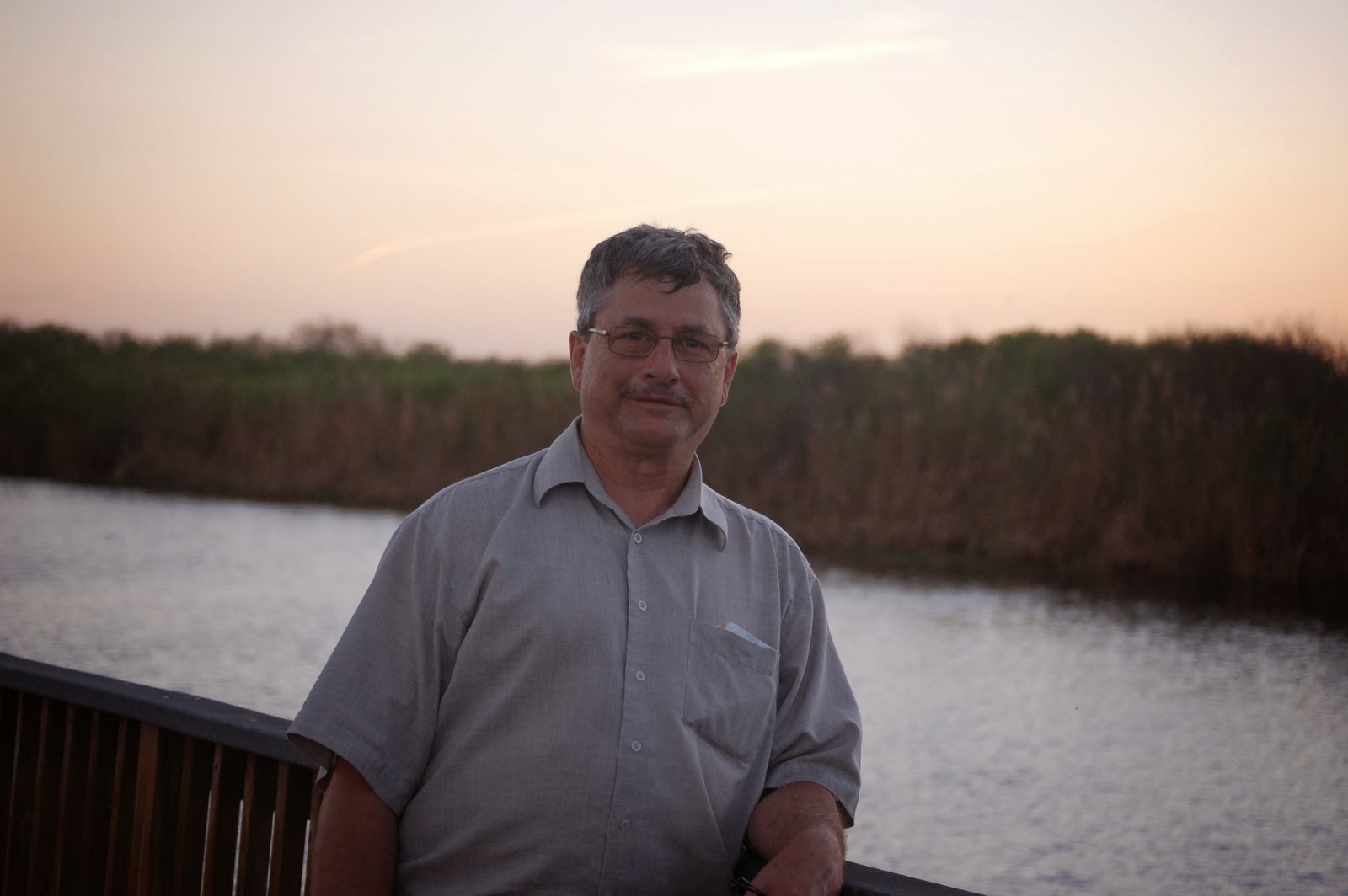
One of the group photographed your blogger at the rail - George's photo didn't rate.

The Pastel-coloured Sky and the Everglades with Blogger
The Bald Cypress grows in slightly raised habitats throughout the Everglades.

Bald Cypress
A flock of White Ibis fly towards their roost in the Loxahatchee.


A very good first nature trip in 2014.  A cold front will move through tonight dropping the temperature 30 degrees, with little recovery expected tomorrow.  Perhaps a good surprise or two will arrive with the fresh breeze.  A la prochaine.

Tuesday, 31 December 2013

Happy New Nature Year

December 31, 2013  Cloudy 73F

Well THAT was interesting. A local neighbourhood walk yielded quite the diversity of birds, including a very robust Red-wing singing his Spring repertoire. Another large flock of Robins seen. It does cause one to reconsider the term "bird brain".

After spending a non-splendid morning and part afternoon at the car shop, I needed some local nature....nature close by not requiring an internal combustion engine.

When that need arises, I walk out my door, down Leithgow Street to Mariposa Avenue, and turn right.  There, half a block down, is the local canal, a water management banality, and yet a bird sanctuary.  There, the neighbourhood Limpkin. This unique bird, not related to herons, or ibises, but more to Cranes and Rails....it does look like a huge Rail, was pictured a few days ago in this Blog.

Two days ago I visited the storm water storage pond up on SW Tulip Avenue. This very large wetland had a large flock of Black-bellied Whistling Ducks.
Black-bellied Whistling Ducks in Flight


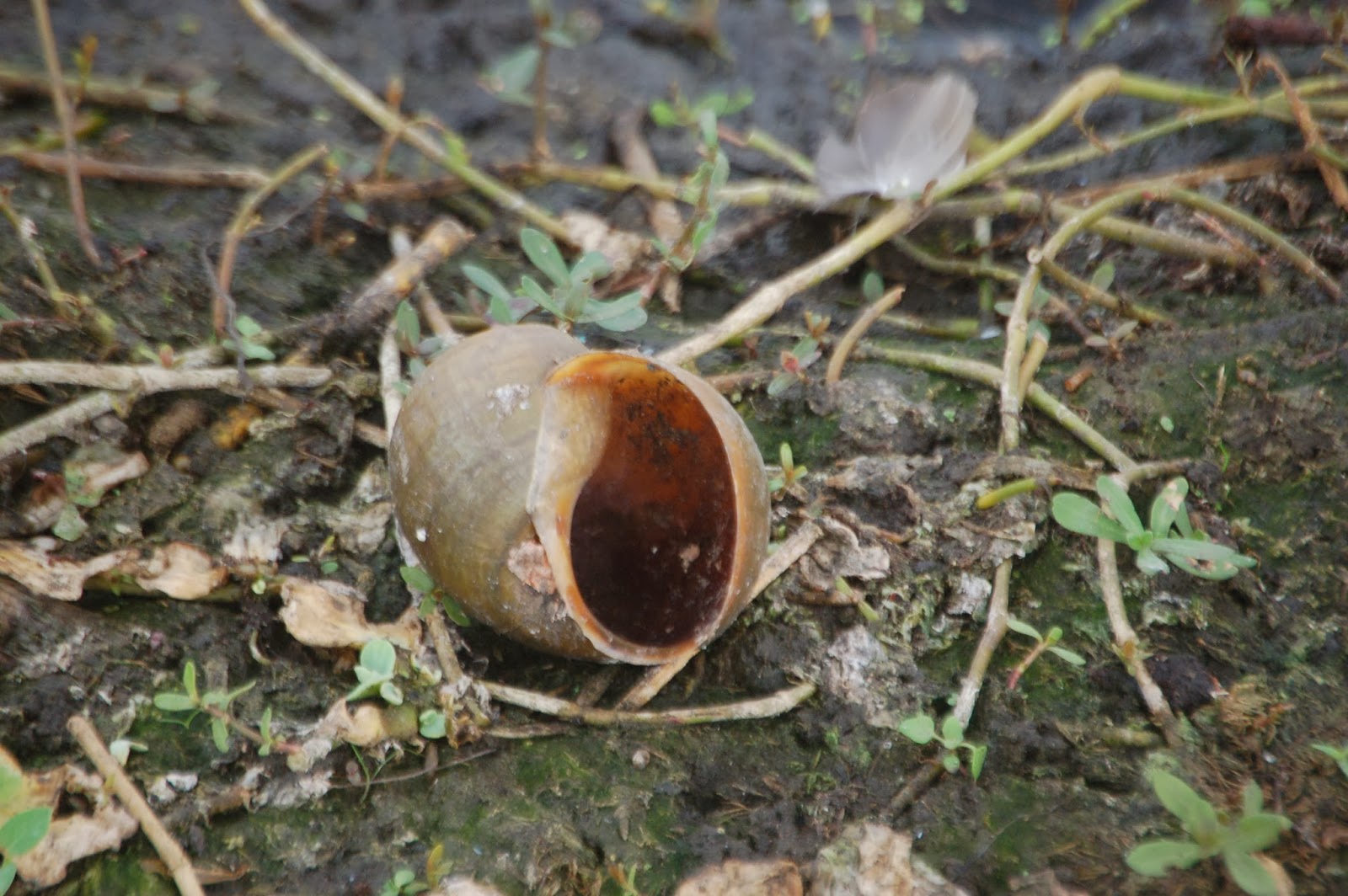
Walking around the pond, I noticed these very large(10 cms long) snail shells all along the shoreline. I learned about these special Florida snails 30 years ago during my first visit to the Loxahatchee National Wildlife Refuge in Palm Beach County.  Here I saw my first Snail Kite, which feeds exclusively on these snails, called the Apple Snail.  After seeing so many empty snail  shells along the edge of the pond, I recalled that a second bird feeds on Apple Snails- the Limpkin.

Limpkins are a tropical bird, which reach the northern limit of its breeding range in Florida's marshes, but only where there is an abundance of Apple Snails.  I went home and looked to see where Limpkins have been seen in this area, and sure enough, the SW Tulip St. pond had  5 Limpkins there recently.

Today, at the canal, I saw the local Limpkin foraging, and then noticed the empty Apple Snail shells scattered along the shoreline.

Apple Snail shell (SW Tulip St.)
Two Glossy Ibises flew by, as did a Wood Stork.  The Mottled Ducks were swimming on the canal.

I then proceeded west on SE Mariposa Ave. to the local small preserve, Mariposa Cane Slough, which has another recently constructed storm water wetland beside it.  The walk through the preserve is always a treat. One can always see Beautyberry and Wild Coffee.

Wild Coffee

Beautyberry
Arriving at the pond at the corner of Lennard and SW Mariposa, I first noticed how well all the planted native plants were doing, including Bald Cypress and native rushes and sedges.  This has attracted quite a diversity of life, including Florida Cooters (turtles) and birds, in addition to the aforementioned Red-wing:  Double Crested Cormorant, Wilson's Snipe, Anhinga, Pied-billed Grebe, Snowy Egret, Cattle Egret and a Merlin.

May your trails, in 2014, yield a diversity of life.

Monday, 30 December 2013

Paleo and Teague Hammocks, St. Lucie County, Florida

December 30th, 2013

This afternoon, I visited Paleo and Teague Hammocks, two large St. Lucie County preserves, in the heart of the beef and citrus farming area in the western part of the County.

Cooler dryer air (about 70 F) has pushed in, and a thin layer of cloud lifted at about 3:30.  Therefore, at 2;00 PM,  I had an hour and a half of great photography conditions (the cloud cover).

Upon leaving the car, I heard a very large number of birds calling from the Teague Hammock (across Carlton Road from the Paleo Hammock parking lot).  I went across the road and then walked up the Teague Hammock Trail towards the rising volume of bird calls.  Among the Brazilian Peppers (an ornamental exotic plant that has become invasive where sufficient water is available) were hundreds, and perhaps thousands of birds feeding on the pepper fruit.

Most of the birds were Robins, with Common Grackles, Blue Jays and about 30 Cedar Waxwings.  This was the greatest number of Robins I had ever seen at one time anywhere......they were moving and feeding in numbers over many acres of the Preserve. Good news for the northerners reading this-many of the male Robins were singing their spring song!

Brazilian Pepper in Teague Hammock

Another non-native exotic from Brazil was seen in the Hammock. Not an invasive like the Brazilian Pepper, and a strikingly beautiful vine, Brazilian Nightshade, Solanum seaforthianum. This plant has also escaped from cultivation in Australia.

Brazilian Nightshade

I noticed a lot of Carolina Satyrs Hermeuptychia sosybius  butterflies along the trail. Also seen in good numbers were Zebra Longwings Heliconius charitonius.

Zebra Longwing, Florida's State Butterfly on Bidens

Carolina Satyr


I then walked the Paleo Hammock Trail. Both of these Hammocks contain large forested tracts and marshes/swamps, which are remnants of pre 19th century and 20th century regional water systems drained to permit agricultural development, mostly beef and citrus farming in this area.
The larger area that was drained was the Alpatiokee Swamp (the term in the 17th and 18th centuries included marshes), a very large area dotted with slightly elevated "islands" of forested dry land, called Hammocks. The Hammocks in the Everglades National Park consist mainly of Cypress and tropical tree species. Here there is a mix of temperate and tropical species, for example, Live Oak and American Elm living close to each other. And, of course, the ubiquitous Sabal Palm is here in abundance
.


Spanish "Moss" on Live Oak
Sabal Palm

The Paleo in Paleo hammock refers to the First Nations that occupied this area in Pre-Colombian North America. There is some evidence that the first peoples were in Florida 10,000 years ago, and there are large mounds in Paleo Hammock Preserve which, along with world war 2 era excavations for the German Canal, have yielded artifacts dating back 2000 years. It is estimated before the Spaniards arrived, that up to 100,000 people lived in Florida in areas like this one. You can read more of this fascinating history, and more about the natural history of this preserve at these two sites:

http://www.stlucieco.gov/beaches/60.htm


Click on "brochure" to learn more about Paleo Hammock.


http://www.sfwmd.gov/portal/page/portal/xrepository/sfwmd_repository_pdf/draft%209_4_09%20allap%20gmp.pdf


The above links to an excellent document containing  much of the water management history of the area.
As a former water manager, I find that Florida's water systems are fascinating, since they account for much of its natural history. Many of the political battles in the State concern water system conservation.


Alpatiokee Swamp, which covered much of this region historically, linked the Cypress Swamp to the north (source of the St. John River) and it was the main source for the St. Lucie River, which flows off to the East, and was contiguous with the great Everglades to the south. It is believed that , originally, the Alpatiokee and the 3 rivers created on continuous system throughout the center of the full Florida peninsula.


When the Spaniards arrived, they began the long tradition of introducing exotic species to Florida's ecosystems. They brought pigs, which now roam and consume anything on the ground, and the Seville orange. Seville oranges were grown in this area in the post Colombian period. Amazingly, local trees survived the two year freeze of the 1890's. These trees were the origin of the Florida citrus industry. Some of their offspring survive in Paleo Hammock. Sevilles are very juicy AND very sour. They are excellent for flavouring a large jug of water.


The local soils are perfect for citrus, once drained. Below are "maroc" oranges and grapefruits growing happily on the reserve without any cultivation.


"Maroc" type orange


Grapefruit in Paleo Hammock

The other major agricultural product in this part of Florida is beef, This is a major beef production area. Both Hammocks originally were part of large ranches, the Teague Hammock preserve includes the family name of the ranch owner. Right next to the preserves are large numbers of cattle and their co-inhabitants, Cattle Egrets, Sandhill Cranes and Crested Caracara.


Driving down Carlton Road back towards Highway 70, I had to stop the car several times, with exciting bird sightings. I saw all 3 of the co-inhabitants mentioned above, as I drove, including the largest fly-past of Sandhill Cranes I have ever observed. There were 64 in one "V" (yes they form "V"s in flight, like Canada Geese). Well over 100 flew over.


Sandhill Crane "Fly Past"


Crested Caracara