More About Me

Allow me to introduce myself. Most of my spare time is dedicated to natural history and environmental knowledge development and communication. I hold an executive position with the Mississippi Madawaska Land Trust, Carleton, Place, Ontario, Canada. I live in Arnprior, the location of the official tallest tree in Ontario at Gillies Grove. It is a White Pine (Pinus Strobus) with a height of about 47 metres. The National Research Council of Canada has placed me on their Animal Care Committee, which oversees the treatment and care of laboratory animals in human health research. I have my own blog, which captures natural history knowledge and more as I make my way through various eco-districts.

Sunday, 17 March 2019

Una muestra de la cultura natural del Arte en España.


Arrival February 1, 2019. Madrid to Malaga by the AVE high speed train (top speed 275km/hr). Arrival in Malaga 2h20 minutes after departing Madrid. Francisco (Andalucians drop the "s") our taxi driver has our names on a sign at the station. He allows us to pick up some groceries in Malaga before departing to Nerja. Cool, very light rain. It is evening in Malaga. We pay Francisco and find our way to the villa in the Oasis de Capistrano, Nerja, Malaga, Spain. We wake up to bright sun (after all it IS the Costa del Sol), and this view. The tall peak to my right is Pico de Cielo, which is 1510 metres high. 

Hurrying to the local supermarket, we found most of the constituents of the Mediterranean diet. Being coastal, this part of Andalucia has a constant supply of fresh seafood. And olives! And olive oil! These green jewels, and their heart healthy oil, are so much more tasty (and less salty) than those available in Canada.
Then we took our first walk (3 Kms.) to Nerja, pictured below, and yes, that is the Mediterranean (Burriana Beach may be seen in this photo).
Back to the patio, and my first (of 175 species) European bird perched and sang close by. The Serin, Serinus serinus is quite common. It sings constantly, and brightens one's day. It is a close relative to the Canary, Serinus canarius, which may be seen here too, as well as in its original home in the Canary Islands, off of West Africa.
Meanwhile, perched on a nearby villa, this White Wagtail, Motacilla alba, became my second European specialty. These birds do indeed wag their tails constantly.  We have also seen Grey Wagtails (photo near end of this blog), which are not quite as common.
Our walks in early February began with a jacket, and ended with jackets in our backpacks. The cool air permitted us to walk, as below, through the local farmlands, with the Mediterranean always in view. Our walks have become longer over time, and more ambitious, with recent walks into Tejeda Natural Park involving a lot of vertical challenges (and in my case, vertigo).
The hills, as shown below, have a mix of xeric species, some of which have escaped cultivation, such as the thick leaved Agaves, below, from California. The tree is a wild olive. Olives, both cultivated and wild, dot, and occasionally cover, the Andalucian landscape.

Below is a view of the Mediterranean from one of the barrancos (gorges) cut through the hard limestone of Andalucia. Fishing boats are not common. We could see only one or two each day. About 20 miles off the coast is one of the world's busiest shipping lanes, as ocean-going freighters ply from and towards the Strait of Gibraltar.
Landscaping around the "urbanicaziones" is typical of zone 10, frost-free climates. For example, the villas are festooned with Bougainvilleas, which are also planted throughout the Caribbean. Below, a typical coastline view around Nerja: red limestones and conglomerates dominate, rising quickly into the Sierra Tejeda.
Oh yeah, if the olives aren't picked while green, they ripen!
We travelled to Almonte, in the southwest of Spain, and stayed at Casa Halcon, an organic olive farm and guest house owned by Angelika and Nigel. Our delightful hosts greeted us, and we then went for a walk along the road, passing by farms. At one farm, this lovely horse greeted Jan, who has always had a great fondness for all horses.
Most of the farms in this part of Andalucia have extensive gardens, with the occasional orange tree (yummy).
The next day, February 11,  was Jan's birthday and when we returned from our tour of Doñana National Park, Angelika had made this tasty and colourful cake.
Then we returned to Doñana (how could you possibly tell?), where...
we saw Flamencos (Greater Flamingos, Phoenicopterus roseus) and many waterfowl, and wading birds....


including this White Stork, Ciconia ciconia, which was NOT seen carring a baby.


Jan was more interested in the numerous wild horses, including some which were clearly Andalusians.
I still like the Flamingos more.  The pink ones are full adults, and the white ones are juveniles.

We ended the day watching Álvaro, our delightful nature guide, helping our host Nigel demonstrate the technicalities of "curing" olives. Jan is seen in the background sampling the wares, with the olive orchard behind her. Nigel had earlier explained that he made olive oil by stomping on the olives with his "Wellies". We concluded that he wasn't giving us an accurate picture! How could he POSSIBLY get into that blue container and stomp? We know better than that, Nigel!
The next day, Álvaro started our tour in the historic, wonderful town of El Rocío, where live some of Spain's oldest olive trees, the oldest over 700 years old. Below is one of these trees.

Álvaro translated the sign below which tells the story of these venerable "árboles".


The town of  El Rocío is where the annual roundup of the Doñana horses takes place. The streets are all wide and sand covered. The restaurants/bars all have places for the Caballeros to have a pint while sitting on their horses. Each year (this year June 9-10), this village of 700 people welcomes Spain's largest pilgrimage, attracting about 1 million celebrants, to what is, at least in origin, a solemn religious experience. See more here (turn translation on!):

https://www.rocio.com/traslado-de-la-virgen-del-rocio-a-almonte-en-2019/


Speaking of religious experiences, Jan and I took the relatively short drive to Sevilla, after bidding our Almonte hosts "adios". This trip will be expanded to a full blog edition in the future. For now, know that we were treated to a very intimate Flamenco show by the three performers seen with us, above. The dancer, beside Jan, managed to demonstrate the force, emotions and vitality of Flamenco in a most visceral way. The guitarist demonstrated the intense professionalism of Flamenco guitar (both hands and all ten fingers active on the guitar). We watched a similar flamenco performance and once again experienced the emotion of this dance form in the caves of Granada.


Curiosity and a quest for knowledge drew us to the Maestranza (full title is Plaza de toros de la Real Maestranza de Caballería de Sevilla), one of Spain's most notable bullfighting rings. The tour included time in the ring (bulls were not present!) We were also treated to the Maestranza Museum, worth visiting in its own right. Aside from bull fighting memorabilia, the museum has an impressive collection of art related to this very Spanish (and controversial) tradition, including 10 original Goyas. The entrance to the Maestranza is below. The tour of the Maestranza includes the chapel where the Matadors pray before entering the ring (the prayers were included on the walls of the chapel). In the ring, the guide pointed out four doors. The one we used to enter is the same door the Matadors use. To the right of that is the very tall door where the horse-riding Picadors enter. To the right of that is the Bull's door. Last but not least, she told us, is the Ambulance door. Enough said.

She added that the seats in the shade (bull fights begin in April and go to October) are 29 Euros. Shade seats, where the notables sit, are almost 300 Euros. "I would take the sun seats for sure," I said. The tour guide then mentioned that those seats are subject to temperatures approaching 45C. "Oh," I said.

Sevilla has a big Cathedral, which originally (before 1490) housed a large Moorish Mosque. The Catholic armies of King Ferdinand and Queen Isabella dispatched Moors and Jews. This sordid history is well interpreted in Sevilla. We followed the tour of the Jewish Quarter (immediately next to the Moorish walls) in Rick Steve's book about Spain.
The streets in the Jewish Quarter are the narrowest we visited in Spain.


The Moorish architecture and tile decorations, including benches such as this one, are eye candy.

Later in the month, we visited the old Moorish town of Frigiliana, in the hills above Nerja. The lovely white stone village also celebrates the 3 religious cultures of "old Spain" in the town's centre (below).

While Jan and son Thomas went off to Gibraltar, I visited Ronda for more nature touring with Álvaro. His brother-in-law runs this marvellous restaurant in Ronda, where all of the wines (above the bartender's head) are regional favourites. I am not the greatest wine connoisseur, however, these wines impressed ( I tried 3).
I returned to my room in the Boabdil Guest House (another great experience) through the narrow moonlit streets of Ronda (below).

Above is the church in Ronda's town square. Note the balconies. Álvaro explained that these were not for religious audiences, but were for the elite to watch 17-18th century bull fights! Álvaro told me a lot more, but those details will need a more expansive separate chapter. So I ended the night comfortably under the moonlight in this ancient Moorish city.
In the morning,  we set off to Grazalema National Park,and other splendid wildlife locales around Ronda, the northern portion of Malaga province.
After a few minutes, I noticed that these Griffon Vultures, Gyps fulvus, were looking quite "fondly" at me. "I am NOT dead yet," I shouted.

Álvaro hard at work finding me some "agriculture area" birds in the Osuna area. While he hunted for birds, I took this photo, below, of an Almond tree festooned with blooms.

Leaving the plains (where it never rained!) we rose up into Grazalema National Park, and found these Giant Orchids, Himantoglossum robertianum  in bloom....
just after spotting these Iberian Ibex, Capra pyrenaica, lounging on the high cliffs.


Above, a rare Ronda goat cheese bought in a very Spanish restaurant (Venta La Vega) 15 minutes to the west of Ronda.


Back to Nerja, and a visit to Las Cuevas de Nerja, the huge, beautiful and colourful location of some of Europe's oldest cave drawings. It is now estimated these caves have housed our ancestors for 40,000 years.


After the Cuevas, the neighbouring Jardin Botanico contained hundreds of native Mediterranean plants, including the Gum Rockrose or Labdanum, Cistus ladanifer, above.
Oh yeah, recall I previously mentioned the Grey Wagtail, Motacilla cinerea. I found this male in the Rio Chillar, on the west side of Nerja.The black bib is a key field mark during breeding season.

With Jan (in the rose jacket) and our son Thomas (the tall person on her right) visited Granada. We stopped in Granada's oldest neighbourhood, Albaicín, at night. Pictured below from Albaicin, the illuminated Alhambra. We  then proceeded to Sacromonte, where Flamenco is performed in caves in which this art form has been practiced for over 500 years. The origin of Flamenco, as in Sevilla, relates to the forced conversions of Muslims and Jews following 1492.

Oh yeah, the Alhambra, above. And the Chapel outside the Granada Cathedral that contains the remains and memorial of Ferdinand and Isabella, as well as other Spanish royalty of the 16th century. Note my, "thumbs down" opinion on their policies!  I can confirm they are still dead, that is, their coffins are still in the crypt.


 Back in Nerja, we enjoyed the swirling colour of Carnaval, below.


I leave you with a view of flowers with the mountains of the Sierra Tejeda in the background (the view from our patio is similar), and also, on our patio, a Trumpet Flower or Angel's Trumpet, Brugmansia arborea,  brightens the view during our noon time meals.


Tuesday, 22 January 2019

Charlotte Lake #5 and Beyond

This instalment takes us away from the botanical to the aesthetic, entomological, and piscivore elements of cottage life. There are two groups of moths that will take your breath away because of their size and colours.  It is best to attract these insects with a special light and a sheet for them to land on.  However, a few will come to a screen illuminated by a simple porch light.  The two groups are the Silk Moths (Luna, Io, Cecropia and Polyphemus) and the Sphinx Moths.  Above is the Modest Sphinx Moth, Pachysphinx modesta,  a wide-bodied 4 inch insect with an array of subtle colours. The larvae love trees of the Poplar family. So if you are near a forest with lots of poplars/aspen, turn on your porch light!
Charlotte Lake is a clear, clean, cold jewel, sitting near the summit of the Algonquin highlands, in the Madawaska River watershed. Although motor boats do use the lake, the summer of 2017 was so wet, that most of the time we enjoyed the cottage, few motor boats joined me, as I paddled and fished (very successfully). Fairly large Yellow Perch, Perca flavescens), Smallmouth, Micropterus dolomieu and Largemouth Bass, Micropterus salmoides, abound. Salmoides means "trout-like", from Latin. I expect that this lake was, historically,  a trout lake . Once bass are introduced, though, most trout species cannot compete. Lake Trout are an exception, however, as they require very deep cold water where Bass rarely tread.

Above is a view from the cottage driveway towards the lake.  This is typical Precambrian landscape, with a rocky, steep, granitic slope down to the lake. I decided on a Perch dinner one day,  and, these are large, for Perch. By mid July, Perch in most lakes are infested with parasites.  These Perch had few.

Back on the dock, a dragonfly visited. Then expired!  Dragonflies live for a few weeks, and after mating, they may fade rather quickly. There are exceptions, for example the migratory Green Darner, Anax junius. This one is also a Darner, most likely a Lake Darner, Aeshna eremita. It was probably much more blue in life.


The lake beckoned Jan, above, out on the kayak, while my son and nephew enjoyed a few hours fishing from the canoe (real fishing that requires effort!). This most relaxing and pastoral scene closes out our time at the Charlotte Lake - Beethoven Pastoral Symphony playing in the background.


Just after returning to our home, I joined an Odonata (dragonflies, jewelwings and damselflies) event at the Morris Island Conservation Area. Morris Island is administered by the Mississippi Valley Conservation Authority.  It was created as a result of the damming of the Ottawa River for the Chats Falls Hydroelectric project. Notwithstanding its artificial origin, this is a jewel of biodiversity, especially for Odonata.

Below, one of the most common damselflies in Eastern North America is the Eastern Forktail, Ischnura verticalis. Females have this orange coloration. Males have a black  thorax above, with green shoulder stripes; pale green sides, and some blue at the tip of the abdomenIn Florida, there are more species of Forktail, including Citrine. They are ubiquitous, and not studied much, as far as I know.


This caterpillar was making slow progress across the gravel trail at Morris Island Conservation Area. Spilosoma virginica is a species of moth in the Arctiinae subfamily. As a caterpillar, it is known as the Yellow Woolly Bear. As an adult, it is known as the Virginian Tiger Moth.


The following information is adapted from the Wisconsin BugLady:http://www.riveredgenaturecenter.org/news/

Slaty Skimmers, Libellula incesta, are in the skimmer family Libellulidae, the most common and brightly-colored pond dragonflies.  Members of the genus Libellula (along with, in some books, the corporals and whitetails) are known as the “King Skimmers,” which Dennis Paulson describes as “some of the most familiar dragonflies to the general naturalist, as they are large and conspicuous, often with distinctive wing patterns” (and he adds the tasty tidbit that the king skimmers typically” perch with the front pair of legs folded behind the head,” which makes the BugLady want to go back and check all of her photos).

From Art: This is true. Count the legs of this splendid male Slaty Skimmer, and you will see 4 grasping the twig.  We all know insects have 6 legs.  Look very, very closely, and you will see the front two legs folded behind its head.

The King skimmers are sexually dimorphic, with males generally more colorful than females (juvenile Slatys are striking, but females fade to a grayish-brown).  They often perch on the top of vegetation in the sunshine, and they hunt from their perch.  The BugLady was curious about this dragonfly’s unusual species name.  She came across an answer offered by Dennis Paulson (Dragonflies and Damselflies of the East, Dragonflies and Damselflies of the West) in an on-line forum: “Hagen [the 19th century German-born entomologist/Harvard professor who named them] applied many strange and often undecipherable names to odonate species. For example, Sympetrum corruptum (corrupted), Sympetrum illotum (dirty), Dromogomphus spoliatus (plundered), Brechmorhoga mendax (lying, deceiving), Enallagma praevarum (unsteady), Enallagma ebrium (drunken).


Sid Dunkle and I, in our checklist of North American odonates, tried to figure out the origin of these names but failed in many cases. For Libellula incesta, we wrote ‘incestuous, perhaps alluding to looking like a hybrid between other closely related species,’ but this was pure speculation. Hagen never explained the etymology of any of his names, and they will remain unexplained.”

Those who have struggled with identifying pond damselflies will recognize the most difficult case, above.  This is a male "blue" type, refering to the predominance of the colour blue on the abdomen, giving this group of damselflies the moniker "bluet". To identify bluets, you need, at minimum, a handheld loupe or magnifier. Even with a good one, identification is difficult for us amateurs. To differentiate these damselflies, you need to differentiate the claspers, in males, such as the one above. This photo shows the claspers, but not in enough detail to make a certain identification. So this is LIKELY one of the 2 most common species, Hagen, Enallagma hageni or Marsh Bluet,  Enallagma ebrium.  However, it may also be four or five other species! Those paying attention will have noted that the first species, Hagen, is named after that Harvard professor, who chose weird inexplicable Latin names for species, and you will recall that the second species is one he named, as "ebrium" means drunk. After that frustrating experience, I was so happy to find an animal I could immediately identify.

It is common to find these snakes basking in the gravel beside the water.  They are very colourful, usually calm snakes, which may grow quite large.  Although, like all water snakes, these are curious, and will not scoot and scurry away like most snakes.  They are quite harmless if left alone.  This is the Northern Brown Watersnake, Nerodia sipedon sipedon. If you visit rural Florida, as I do, you probably have encountered the Southern Brown Watersnake, which is similar. Unfortunately, people often mistake that snake for the venomous Cottonmouth. During winter, Cottonmouths are difficult to find, whereas the Watersnakes are often seen. Leave them be if encountered. They will not bite unless they feel threatened.


Some more Skimmers, which seem to pose to ensure you admire them. The striking Halloween Pennant, Celithemis eponina,  above, is a kaleidoscope of colour and pattern. Note the pink pterostigma at the front edge of the outer last brown stripe on each wing. These, and the pattern, make Halloween Pennants easy to identify. This is a male, though the females are also very colourful and similarly patterned.

Below is one of our most common Skimmers, the Common Whitetail, Plathemis lydia.

I promised some diversity and this includes the reptiles and amphibians. Above, an Eastern Gartersnake, Thamnophis sirtalis sirtalis and below American Bullfrog, Lithobates catesbeianus. Most people have trouble differentiating the Bullfrog from the Green Frog. A helpful site for all of Ontario's (and surrounding bordering States/and Quebec) reptiles and amphibians:

https://ontarionature.org/programs/citizen-science/reptile-amphibian-atlas/species/


Ending with a bit of sex in the Hollywood tradition: Below, a male Bluet clasps the neck of a female Bluet in the tandem position. If mating proceeds, the male and female will form a "wheel" so that the male's sperm transfers from his genitalia at the base of the thorax to hers, which are just behind section 8 of the abdomen.
In the next instalment, we take a trip "up the Ottawa Valley" and afterwards, we join the Mississippi Madawaska Land Trust on one of their outings. See you then.

Monday, 31 December 2018

Charlotte Lake, Renfrew County, Ontario July 2017 #4


You can't have lovely Monarch Butterflies without this plant, shown above.  This is common Milkweed, Asclepias syriaca, the most widely distributed milkweed in our area.  We call it a weed, but look at those flowers!  Stunning!  Monarch larvae (caterpillars) feed ONLY on milkweeds.  Another milkweed found in our area is the Swamp Milkweed, which is even more colourful.

Above is another photo of Aralia racemosa, or Spikenard, an uncommon relative of Sarsapirilla, as detailed in a previous blog in this series.  This is a splendid shrub-like (3-6 feet high and wide) flowering plant that would be a great addition to any backyard in our area.  Look for it in a wildflower garden centre.

The Charlotte Lake cottage that we rented is on a very long private road which is maintained by local residents. We were fascinated by the simple and effective method for grading the road: an ATV dragging a metal grate weighed down by concrete blocks.


Above is Hairy Wood-mint, Blephilia hirsuta. Note long stalks of leaves differentiate it from Downy Wood Mint.  Also, as "hirsuta" suggests, it is hairy along leaf stems. The Mint family is well represented in North America with many species which are widely distributed.  You may recognize a close relative of this forest plant: Heal-all or Self-heal, Prunella vulgaris, which, if you are silly enough to maintain a lawn, you have probably pulled on numerous occasions. The name of the latter plant derives from its traditional application as a sore throat remedy. I prefer Ricola. This throat lozenge contains extracts from 11 herbs, including several common Mint family plants. Most cough drops contain menthol, which, as the name suggests, is an alcohol derivative of mint oil.


Above is a small flowering plant with round basal shiny leaves, and white flowers with protruding stamen: Round-leaved Pyrola, Pyrola rotundifolia. 
 The Pyrolaceae (Pyrola family), now considered a sub-family of the Heaths, is well represented on our forest floors. Some of my favourites are the Wintergreens...always a thrill to a young person to savour their first Wintergreen leaf...and the Pipsissewa.  Don't try pronouncing the latter after 3 glasses of wine. The results might be, umm, unintentionally entertaining.

Tall Meadow Rue, Thalictrum polygamum, above, is a deep forest plant which is not often seen flowering. This was my lucky day.
Marsh Bedstraw, Galium palustre. Note this species lives in wet places, is weak stemmed (this one certainly is) has 6 leaves in whorls and  WHITE flowers (Northern Bedstraw is more erect with white flowers, and has 4 leaves in whorls). Of course, the best way to identify a plant, or anything else in nature, is in the field.  As you can see above and below, the field guide is with me, and the plant may be compared directly to the description, drawings, and photos. Bedstraw has tiny white 4-petaled flowers. The size compares to the weave of my lovely Levi Jeans (541's...more stretchy for an old waistline!)


Common Speedwell, Veronica officinalis is a species of flowering plant in the Plantain family Plantaginaceae. It is native to Europe and western Asia. It has been introduced to North America where it is widely naturalized.


Above  is a buttercup. You already knew that! You used to hold one of the flowers under your chin to prove you liked butter.  There are 7 species of Buttercups (Ranunculus spp.) in our region. Some of them are native, but the most common one (probably the above specimen included) is Tall Buttercup, Ranunculus acris, which is exotic, and invasive....but still delightful to us kids! If you want to know which species this is for certain, take a photo of the leaves! I didn't. Mea culpa.


As you will appreciate and recognize, this series of photos was taken to review some of the more widespread, common, and often exotic flowers we see in summer in open spaces, and along roadsides, fields and trails.  The flowers above are not associated with most of the leaves, which appear to be nettles and grasses.  The flowers are the exotic, and ubiquitous Chysanthemum leucanthemum (a rhyming mouthful), or Daisy.


Another common import from Europe is the Rough-fruited Cinquefoil, Potentilla recta.  I love the notched petals of the subtly coloured flowers. French speakers will recognize the common name means "5 leaves".  Ironically, this species usually has 7 leaflets on each leaf stock.


A great Yiddish word is "kvetch", which, roughly translated means "constantly complaining". I always think of that word when I see this plant: a non-native member of the Pea family called Cow Vetch, Viccia cracca. Like most of this family, the roots fix nitrogen, enriching soil. The flowers are rich in nectar, attracting bees and buterflies. As the name suggests, this is a sweet cattle favourite.


Of course, you also popped the above "fruits" of the ever-present Bladder Campion, Silene vulgaris, or, if you are in the USA, Maiden's Tears (awwwww). The fruit is actually the calyx, enclosing the green seed-bearing fruit.  At this stage, if you pick the fruits, you can pop them against your hand.  When they flower, the calyx is a lovely pink colour (and they are a member of the Pink family), and the petals are white. They are so lovely.

In their native Europe, these plants are treasured as a salad constituent, especially in the southern Mediterranean, where the young shoots and leaves are added to salad. Older leaves are boiled or fried, according ot Wikipedia. When I visit Spain in February, 2019, I will attempt to corroborate this.


Another treasured "weed" is the Common St. Johnswort, Hypericum perforatum. This native of Mediterranean Europe and North Africa (like the Bladder Campion), was introduced to North America by the invading European humanoid bipeds. They brought it with them because it has always been used in traditional medicine. It has been shown to have some anti-depressant qualities, though not sufficient to replace prescription medications. Enjoy its colour and leave it be!

St. Johnswort is also toxic to livestock, and is therefore unwelcome in pastures.

The name derives from traditional harvest on St. John's Day (June 24). The Latin name is derived from Greek (hyper=over and eikon=picture), since sprigs were hung over photos on St. John's Day to ward off evil. Hmm....I wonder if I could use it over a photo of Donald Trump? Which reminds me of my peridontist's joke, as he was pulling my tooth a few weeks ago: "Nickname for Donald Trump? The Manchurian Cantaloupe." An explanation is available for a small fee.

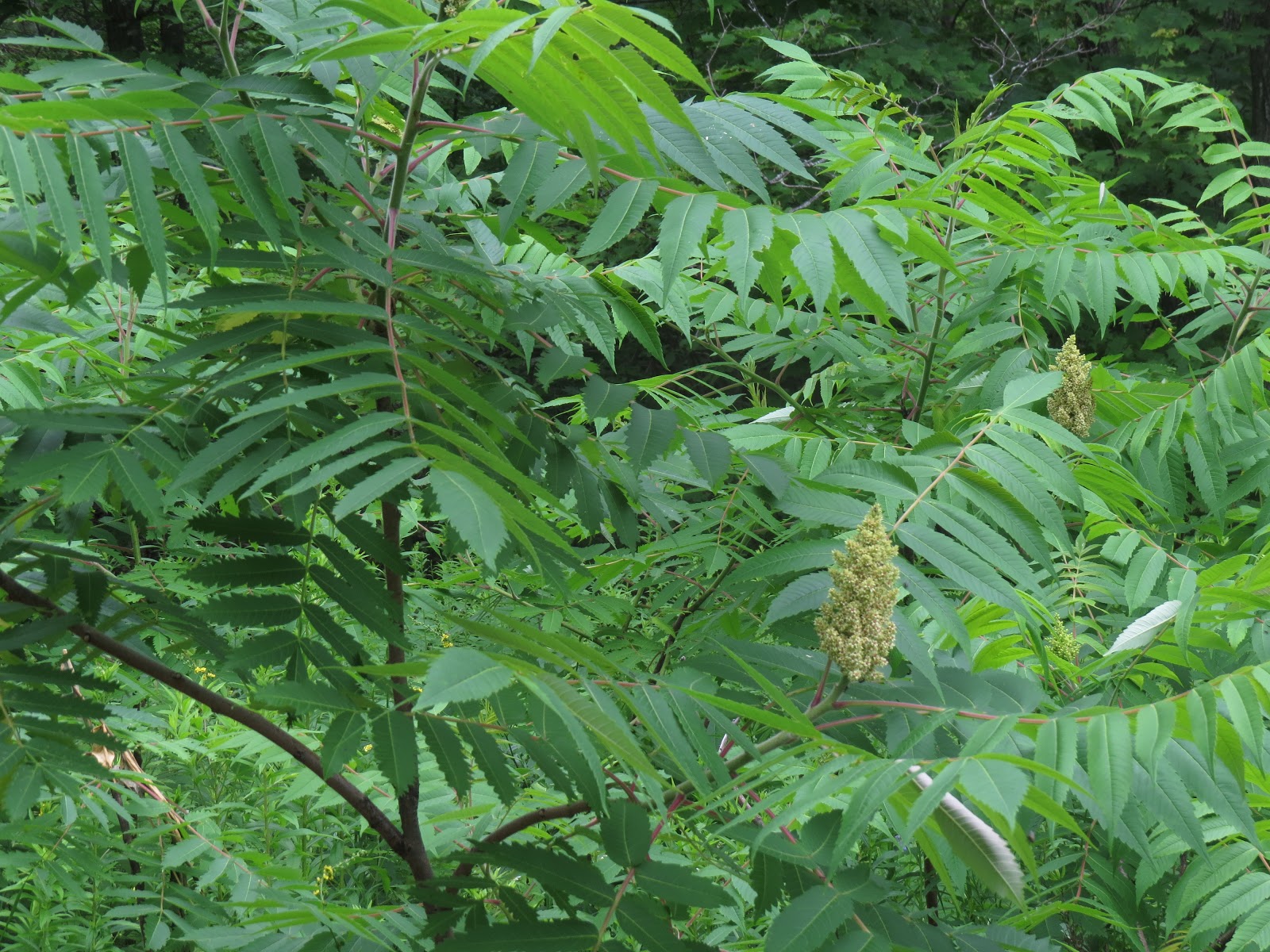
This is an introduction to a few native plants that have become more successful due to agriculture and development. Above is Staghorn Sumac, Rhus typhina. The staghorns turn their familiar reddish colour later in summer, when birds, pollinators and me all partake of their tangy flavour.  They make an excellent herbal tea, the tanginess is due to Vitamin C.  Beware  though, some people may have allergies.

Staghorn Sumac is native to Eastern North America, and it is planted elsewhere. I have one in my garden. The downside of this great fast growing tall shrub is that it spreads through underground stems that have to be continually cut during spring and summer.  I think the result is worth it.

Staghorn Sumac is one of many plants in the Anacardiaceae family, which includes poison ivy  and poison sumac. The family includes other familiar fruit bearing edibles, like mangos and cashews.
Another familiar eastern native flower is the Black-eyed Susan, or Rudbeckia hirta. This colourful flower dominates my garden in late summer. With this plant's close cousins, the Coneflowers, Rudbeckia flowers are native to most everywhere on this continent.

Next year, get a few of these "weeds" in your garden. They are well adapted to our conditions in the Great Lakes Region, and therefore, require much less care than those unwanted exotics.

We will conclude our "Charlotte Lake" series next time, and include some post cottage August favourites.