More About Me

Allow me to introduce myself. Most of my spare time is dedicated to natural history and environmental knowledge development and communication. I hold an executive position with the Mississippi Madawaska Land Trust, Carleton, Place, Ontario, Canada. I live in Arnprior, the location of the official tallest tree in Ontario at Gillies Grove. It is a White Pine (Pinus Strobus) with a height of about 47 metres. The National Research Council of Canada has placed me on their Animal Care Committee, which oversees the treatment and care of laboratory animals in human health research. I have my own blog, which captures natural history knowledge and more as I make my way through various eco-districts.

Sunday, 22 July 2018

Crazy Horse and March Highlands-Ephemerals a month later

May 9, 2017 Still cold....flooding everywhere...rains not letting up.

Quite different than Tennessee here, isn't it? A month later, Tennessee was way warmer than Ottawa and surroundings.  You will see Jan's jacket in the last episode. She has it around her waist.  Today, she has it on.

Some ephemerals were making an appearance.  We walked along the Crazy Horse Trail (to be reprised in 2018) until flooding turned us back.  We did see a few flowers:

This one, above and below is common and easily overlooked, as the yellow-green flowers fail to impress.Later the round light blue fruit will appear.  This is Blue Cohosh (Caulophyllum thalictroides).
They look very enticing. From the GoBotany website (New England) we learn:

"Blue cohosh is an attractive wildflower, with an unusual display of the spherical blue fruits held stiffly above the leaf canopy. The roots were widely used my Native Americans as an herbal medicine to treat a range of ailments and as a general tonic."

From the Government of Canada's Biodiversity Information Facility (who comes up with these names??):

"The plant contains chemicals that can cause cell damage. Experiments show that handling powdered root can cause irritation of mucous membranes, with possible dermatitis. No case histories of poisoning were found in the literature, but the plant has poisoning potential. Children should not be allowed to eat the attractive blue fruits of this plant (Muenscher 1975, Lampe and McCann 1985). No references were found of poisoning of livestock."


Another "just-about-to-flower-plant-which=would=look=way=better-if-it-was-flowering-and-which-I-almost-overlooked-because-looking-down-the-leaves-appeared-to-be-more-maplish" is an uncommon plant: Two-leafed Toothwort, Cardamine diphylla. It appears to become more common in the southern deciduous forests, but it isn't commonly found west of Ottawa, where the tend is toward more acid soils.


Another more common deciduous forest ephemeral is the ubiquitous "Trout Lily" Erythronium americanum, which is found right down to Georgia. Note the young maples on the forest floor dwarfed by the huge (haha) lily.

One of my goals is to be able to identify wild trees and shrubs, especially the more difficult ones.  There are 9 Serviceberry species (Saskatoons out west)in our area, and this is one of the more spectacular ones. Pictured above and below, you will see the fuzziness on the new leaves/flower stocks and the clusters of 5 petaled white flowers. The fuzziness distinguishes this plant during Spring: Downy Juneberry or Downy Serviceberry or Shadbush, Amelanchier arborea. Look out at the forest if you are a car passenger this tie of the year, The clusters of large white blooms do stand out, even from far away. The lovely blueberry-like fruit is excellent eating if you can find them before the birds gorge on them.

Speaking of flowers, the above three are Jan (note the coat, as previously mentioned, and her two blooming friends Glenda (pink) and Sandra, who is ignoring the downy Serviceberry over her right shoulder.We had left the flooded Crazy Horse Trail and continued our hike on the March Highlands Trail, where the beaver lodge looked to be actively used. A developer owns this property, and we fear its loss in the not too distant future unless our city comes to its senses.

Development of suburban subdivisions in North America is driven by money driven local politics.  It has to stop as it is eating up our wilderness in the Great Lakes region and our farmland. It is also reducing habitat for animals like this Great Egret, Ardea alba (top) which has just started to nest in our area since 2005...Climate Change? And this Ruby-crowned Kinglet,  Regulus calendula  (it is often you can SEE the ruby colouring)

Next time, a word about the Mississippi Madawaska Land Trust, then on  to the summer cottage at end of June, with, maybe, perhaps, possibly, a sighting or two along the way.

Saturday, 21 July 2018

Turn, Lift and Sparkle.....A Tennessee Walk

April 9, 2017 Sunny and warm Sunday in southern Appalachia.

Jan had not seen or experienced Falls Creek Falls State Park, Therefore, we spent Saturday stuck in Atlanta traffic after leaving the Okefenokee, arriving at the Park and our motel styled accommodation in the Park at a late hour.

We woke up to splendid breakfast at the Park restaurant, though I had feared missing it due to the late hour.  In my seventh year of retirement, many previously vital bits of knowledge are much less vital. One of these bits is the time!  As it turned out, we had crossed into Central Time, and were an hour earlier than thought. Serendipity!

As we left the restaurant, we met and talked to an obviously fashion-conscious visitor who took a photo or two of us. We learned that she had some model/photography experience. We therefore learned to TURN, then LIFT, and then SPARKLE, whereupon the shutter is released.


Janice pictured trying out this new process on one of the Park trails. As in the Ottawa Valley, Spring ephemeral flowers abound before the deciduous trees leaf out (6 weeks earlier here).

Two of these are below, Azure Bluet, Houstonia caerulea, which blooms in June in our area, and the omni- present Viola sororia, the Common Blue Violet, which appears in my garden in late April.


Fall Creek Falls is well named, as you can see from the typical photos taken on the trails.  The mountains are alive with active streams in Spring, bringing in migratory birds to mix with the local residents.  The large park is a favourite in the southeast.  SO if you decide to go, try for April weekdays!

Otherwise, you may experience some crowding on the rope bridge across the gorge.....

Jan sets out and crosses with little difficulty...BUT
on her return two LARGE mountain men trailed a tad close, causing a few moments of anxiety. I crossed the year before. It being a weekday, I was alone, and successfully challenged my panic driven fear of heights.

Signs always intrigue us, especially those that cause wonderment, like this one:


After this experience we traveled back to the Ottawa Valley for a second spring ephemeral experience.


Monday, 11 December 2017

Remember Pogo and Albert? Day 2


Chesser Island Homestead, Okefenokee National Wildlife Refuge

Saturday April 8, 2017  More sun and mild temperatures.

All three of us made our way back to the Refuge in the morning. We decided to explore the Chesser Island Homestead, an interpreted 600 acre farm on a dry island in the Okefenokee where the Chesser family eked out a living in the late 1800s, through raising livestock, harvesting the sap of the Slash Pines (turpentine), raising sugar cane, hunting and smoking meat/fish, and working in the Refuge after it was created in the latter part of the Great Depression (1937). Tom Chesser stayed until 1958 with the blessing of the Refuge, only leaving to follow wife Iva to Folkston, where she found the proximity to services somewhat more amenable.

Local history is the subject of several websites, including some Wikipedia entries.  If interested, read on after luxuriating in this blog!:


You may also read about the industrial history of the "swamp", including the Suwannee Canal (used today as the origin of the eastern-side boat tours, such as the one I featured in the previous blog edition), and the attempted draining of the area in the 1890's, as well as the great fire of 2011, which burned over 75% of the Refuge:


Arriving at the Homestead, we were fortunate to find volunteer Gordon Saager, who provided us with a very informative tour.  Gordon knows the Chessers, some of whom also volunteer at the Okefenokee National Wildlife Refuge(NWR).  Our tour gave us his personal insights, and we shared a lot of our farming knowledge. We learned much more about southern farming from Gordon,  for example, the process for tapping the Slash Pines reminded me very much of our Sugar Maple tapping for maple syrup. Above is a photo of Gordon, Jan and Winston in front of the Chesser home.  Below,  is a full house photo with the same three posing!  Note the white sandy soil.  Growing anything on this sandy substrate was a challenge.


Thanks Gordon, for this photo of your three guests.  Below as the sign says, you see the water well technology....a hollow log.
We then toured the out buildings, amidst Spanish Moss festooned oaks.  Note that the local lumber trade focused on Cypress and Pines. Cypress has many of the same qualities of our local White Cedar (Arbor Vitae) in Eastern Ontario, except that Cypress trees are giants compared to Cedars.


It being early April, a lizard's heart turns to romance. The Homestead was humming with wildlife romance, including the beautiful male Fence Lizard (in the following the two photos) showing off for a nearby female.


 Fence Lizard , Sceloporus undulates (male) above and below


 Fence Lizard (female)-note the "ladder" pattern on her back.

We left the Homestead and took a trail back into the wetlands, where we spotted this lovely turtle:
Florida Red-bellied Cooter, Pseudemys nelsoni, which obviously ranges into the Okefenokee in Georgia. Notwithstanding the name, I had never seen this turtle in Florida.

Thanks to the staff at Okefenokee NWR for putting me into contact with Gordon.

We left the Okefenokee,  and memories of Pogo and Albert,  and ventured into Tennessee for the next chapter of our adventurous route home.

Sunday, 3 December 2017

Remember Pogo and Albert? Day 1

Okefenokee National Wildlife Refuge, Folkston, Georgia, April 7, 2017, 4 PM and still gorgeous out!

Arriving in the late afternoon from our winter haunt in Dunnellon, Florida, we were up for a boating jaunt into the wilds of the Okefenokee National Wildlife Refuge.  I had already explored the early April beauty of this 350,000-acre wetland, which lies just north of the Florida-Georgia state line.  Jan was looking forward to her first visit.  Winston, as seen below, was right into it, so to speak.  The rainfall sourced bog and swamp supplies water to the St. Mary's and the Suwannee Rivers.


The tour boats do not allow dogs, so, even though Winston isn't much of a dog, we had to find alternative arrangements for him. Thank goodness he is cute.  The staff in the office were happy to keep him for the duration of our exploration tour. Most of the alligators (there are 20,000 estimated in the Okefenokee), were also quite pleased to dog sit; however we thought that might not be the best approach.

You can see the broad smile on this largish 'gator indicating a Winston welcome. We found the 'gators to be very interested in our presence

As we passed the tall "Spanish Moss" festooned trees along the canal, we enjoyed the clear cool April air, and plentiful wildlife.  More large smilin' 'gators greeted us every few yards, as the sunned amidst the native wetland flora, with birds singing from every corner of the swamp.  The boat makes no noise, and leaves no wake, thereby enhancing the  full sensory experience. In fact, as we wended our way, one large bull alligator let out a hiss and a roar, which caused Steve to say "'guess we were a tad close to that one!". This gave us quite a chuckle.

This time of the day, everyone is quite peaceful and liable to rest and bask, including this Great Blue Heron.....
...notwithstanding another large alligator not far away. The alligators are temperature regulating, not smiling, with their mouths open. However, I still like to think that they are smiling.


Then we left the Canal and entered the bog.  Okefenokee (a word in the local Muskogee or Creek family of Native American languages, the same language group spoken by the Native Americans in the Dunnellon Florida area) means "trembling earth" and refers to the Spaghnum Moss layered "ground" in the bog, which trembles when one walks upon it.


Just like here in Eastern Ontario, where I live during acceptable weather, bogs are typified by a community of plants that can adapt to the nutrient poor wet environment, like this Pitcher plant (bloom below).
Another stunning wetland plant that doesn't quite reach our area is the Orontium aquaticum-Golden Club (below) which I also featured in this blog on my last visit to the Okefenokee.

Steve, our guide (the one here sporting the classic hat, shades and a long white beard) was so very knowledgeable about the history, natural history and ecology of the Okefenokee, as we meandered from the Suwannee Canal into the bog portion of the Refuge. As you can see, only one other person joined us on this "last tour of the day".  This provided us with the opportunity to ask Steve about local biology/ecology.

As we curved and rounded our way along the Suwannee Canal and back to the dock, Steve told us about the early history of the land and its people, who eked out a living in this difficult environment, leaving behind their homesteads when the Government of the USA created the Refuge in 1937. One of those homesteads has been preserved by the Refuge, and interpretation of the history of this land is available. You will be able to learn a little about this aspect of the Refuge in my next blog instalment.
Meanwhile, with the moon rising, it was time to collect Winston from the caring folks at the office and return to our temporary digs at Kingsland,  Georgia.

Friday, 18 August 2017

Muir's “go to” Place, More history, Human and Natural

March 10, 2017 Another sunny and warm day in Florida


 As with the visit to Fort Cooper, we start with a Green Heron posing for the camera. From Dunnellon, we go north and a little west up highway 19 for 90 minutes

Rosewood, Pencils and Muir

Passing by the former town of Rosewood,

Rosewood, Florida history

 site of one of the most horrific racial incidents in US history, we reach Cedar Key, one of  the few places developed in mid 19th century Florida. 

John Muir knew about this island in the sun, so he set out from Indiana on foot, arriving in Cedar Key in October 1867 after a stroll of 1000 miles. I have copied the State historic plaque for you to read a snippet of this man's monumental contribution to North American conservation.


Typical museum piece and plaque- the fire reel above (1929), is resting at the State Park museum. The hard-to-read plaque is below. Any photo may be "right-clicked". Choose "open in new tab" in the drop down menu. You will then have a larger (and in this case, readable) version of the photo.


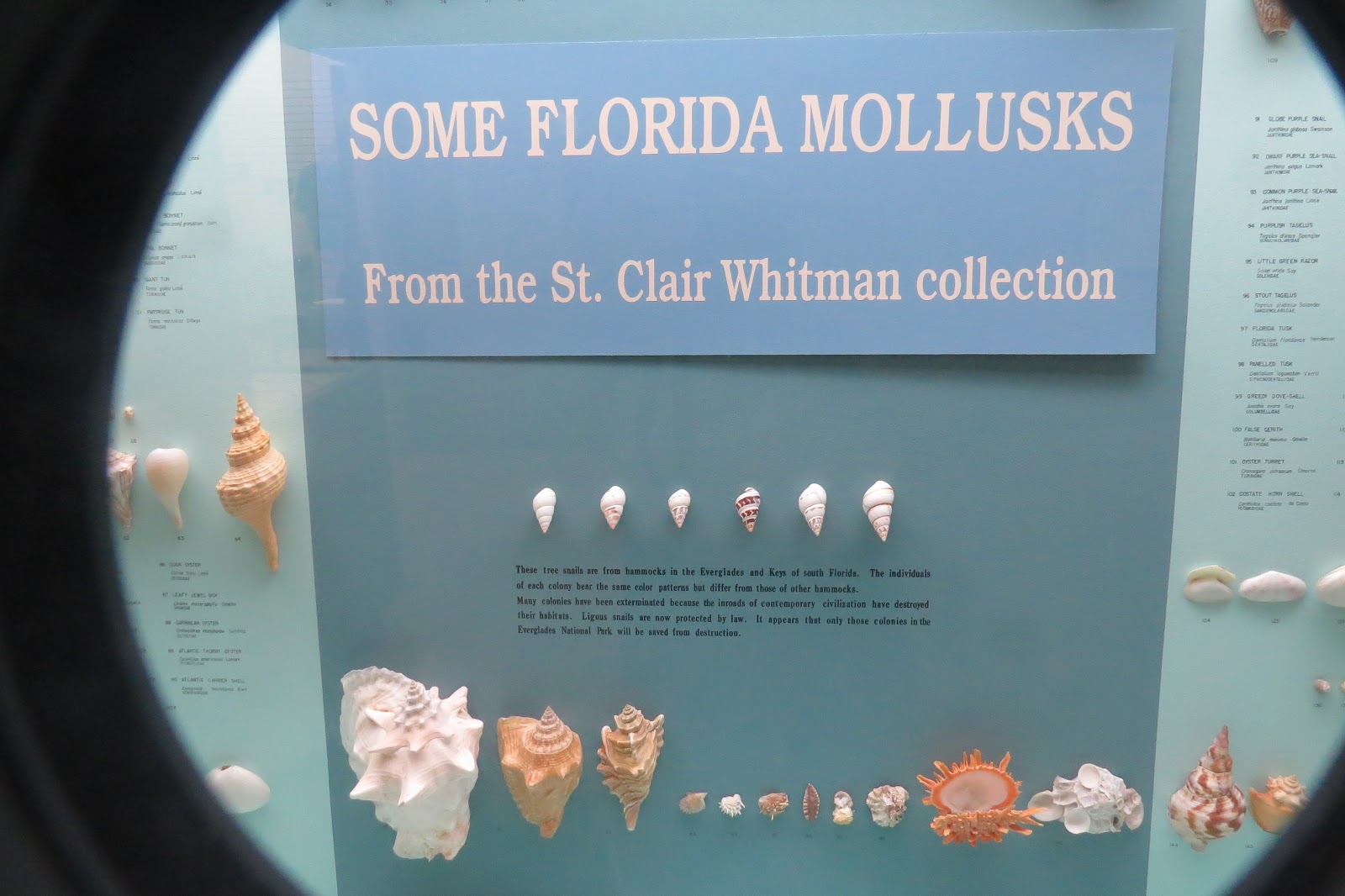
 Cedar Key State Museum is a Florida State Park.  The museum displays items (see part of very comprehensive shell collection above) collected by Saint Clair Whitman, a local resident who established the first museum in his home. The St. Clair Whitman family home is shown below.

Excellent pictorial history of Cedar Key...that is until the last few years when cats (ugh) are prominent.
 The name of the island, Cedar Key, derives from a once prominent local tree, which you have seen elsewhere on this blog: the Southern Red Cedar,Juniperus silicicola, which like our Northern Red Cedar, Juniperus virginiana, isn't a cedar, but, as the Latin suggests, a Juniper.  Note: many botanists do not differentiate the two junipers, listing both as "virginiana". 

The Red Cedars were very prominent in the mid 19th century, when the Faber Pencil Factory harvested them for their pencils.  I recall using Faber pencils back in grade school, and, indeed, they did have the characteristic juniper wood scent, though not from Cedar Key, since the supply ran out in the 19th century.  You can see some nice scattered trees today.
 Walking around the neighbourhood, we came across this Eagle's nest. The two young Bald Eagles, or Eaglets,  were just about to fledge.  The one on the right was exercising its wings.  Typically, Eagles in Florida lay eggs in January. So mid-March fledging is not unusual.

Then....The Suwannee...finally, after a year of planning to get there.....


 The Suwannee River runs into the Gulf of Mexico just north of Cedar Key. Thankfully, this part of the river is protected as a National Wildlife Refuge. Here is what is looks like:

We walked along the Suwannee River Trail, resplendent with March flowers, and came out upon the river.


The Butterweed, Packera glabella, above, and Horrible Thistle (it's HUGE!), Cirsium horridulum,   below, are both well-named flowering plants of the Suwannee Valley.

Winston, below, enjoys (?) a Suwannee River view.

Later, we would go to the Okefenokee National Wildlife Refuge in Folkston, Georgia.