More About Me

Allow me to introduce myself. Most of my spare time is dedicated to natural history and environmental knowledge development and communication. I hold an executive position with the Mississippi Madawaska Land Trust, Carleton, Place, Ontario, Canada. I live in Arnprior, the location of the official tallest tree in Ontario at Gillies Grove. It is a White Pine (Pinus Strobus) with a height of about 47 metres. The National Research Council of Canada has placed me on their Animal Care Committee, which oversees the treatment and care of laboratory animals in human health research. I have my own blog, which captures natural history knowledge and more as I make my way through various eco-districts.

Friday, August 18, 2017

Smokin' Hot Trails

Inverness, Florida March 21, 2017

Having just visited Fort Cooper State Park (see separate blog entry on Fort Cooper in March 2017), Jan and I decided to visit the much larger (50,000 acres, about one third of the Withlacoochee State forest) Citrus Wildlife Management Area (CWMA). It is host to some unique habitat (sand hills and caves) and species, red-cockaded woodpeckers, gopher tortoises and indigo snakes.

 
There are many trails in this huge tract, and we chose one that had some interesting sightings on Ebird.  CWMA is the 8th best birding spot in Citrus County in terms of number of species. Another species of interest to me is Bachman's Sparrow, which was seen in the tract as late as June of this year. My interest in species named after Bachman was piqued when I visited the Magnolia Estate in Charleston, SC in December. Rev. Bachman hung out here and hosted J.J. Audubon on several occasions and he worked closely for decades with Maria Martin, Bachman's sister in law.

The sparrow and the short-tailed hawk are birds that have eluded me in Florida, so I intend to return to this tract to find these two species and others. Whooping Cranes regularly visit the lakes just to the east of CWMA. The Inverness lakes host a variety of water-loving birds.
 
Before setting out,  we took a short walk near our cabin where the Dragonflies and Damselflies were plentiful.  Among those we saw were:


 Male Pond Hawk Dragonfly
 Rubyspot Damselfly (same group as Jewelwings), possibly Smoky Rubyspot, Hetaerina titia .
 Rubyspot Damselfly, possibly  American, Hetaerina americana.

My luck, that the Rubyspots I observed had none of the ruby colouring which characterizes this  genus.  Identification is very difficult without these markings. We had also been seeing many large and colourful Swallowtail Butterflies, including:

 Pipevine Swallowtail, Battus philenor

We then drove to the CWMA, parked close to the trail we had chosen and started to walk.  This Sand Pine, a Pinus clausa small pine of very sandy areas. The local subspecies is known as Ocala Sand Pine. It needs fire to reproduce and to maintain populations, which, coincidentally, the Florida State conservation staff decided to show us in person.....

So we trekked onto the trail, observing the various trees spread out, savannah style, and then we came upon a very recent controlled burn.....


so recent that is was still smokingin some places,

making life difficult for this Prickly Pear Cactus, above.

As you can see, pine cones not only survive the fire, but the seeds inside needs fire for germination. Of course, Winston, below, was both unimpressed with the heat and lack of shade (the pink tongue searched longingly for water_.

Some of the stumps of unwanted trees were still burning (above and below)

I read online a paper that declared the very noxious invader originally from South America, below, as having an uncertain "fire status". It was thought that the Tropical Soda Apple, Solanum viarum, would only be "top killed" by fire, since the roots survive. The photo may indicate that even the above-ground portion may survive fire OR the plant quickly regenerates and blooms! I have featured this plant in a previous blog, where you can see the fruit. The observant reader may notice the genus name Solanum, as belonging to the same group as the Nightshades, Tomatoes and Potatoes (Solanacaea).


We did have a great walk, found a few birds, like the Eastern Towhee,
Pipilo erythrophthalmus, already occupying the fire-resistant shrubs. We all survived the sunny warm day, enhanced by the burn. 


Tuesday, August 15, 2017

Fort  Cooper State Park , Florida and the Seminole Wars 

March 11,2017

Fort  Cooper State Park , Florida and the Seminole Wars:  One time that indigenous people didn't lose


Our morning walk revealed several opportunities for close-up wildlife experience...the Green Heron above, and Alicia, the Alligator below.


A Florida State Park historian gives us the background for the historical recreation event. Which took place in 1836, when another ranting demagogue, Andrew Jackson, occupied the White House.


This man told us all about African American slaves who escaped their shackles and joined with the Seminole. Many migrated to the Bahamas before and after the Seminole wars. Some wound up in the west, especially Oklahoma. You can read a more comprehensive account here.


Major Cooper, and his horse Terminator (name of this horse owned by the actor!), while awaiting the return of General Scott, led his men out of the fort to encounter the Seminole, who were not in the least put off by the American troops. Incidentally, the Seminole had better guns than the soldiers.


One would expect that the Seminole warriors were a tad younger than these gents, but you have to love their enthusiasm, and dress!


That is, until I spotted this colourfully dressed younger man, firing off his musket with gusto. He seemed a smidgeon more, ummm authentic!


The invasive soldiers even had a cannon, which made a loud boom, and scared the birds, The Seminole suffered nary a scratch from all this bluster and muster.


For comparative purposes, here is the authentic Seminole with two of his less authentic colleagues:) I learned a few more things from the man on the right. For example, the Spaniards were known to name the indigenous people they met (prior to making their lives miserable) according to what they understood from the indigenous language being spoken. This practice was continued by the other European invaders. Therefore, when some Europeans traded with indigenous people from the swamps of southeast Florida, they asked the people who they were. The people of the local nation interpreted the gesticulations as “Where are you from” and the answer was “me -ame”, which means something like “over there, that way”. So the Europeans thought they were called Miamis .Heh.


I also learned I had been mispronouncing Seminole. The final “e” is pronounced in a soft “e” kind of way. This is similar to the soft sound that ends Iroquoian words. North American indigenous languages may be more connected than many of us thought in the past.


Afterwards, your joyful blogger sought out a few of the combattants. The one to my right turned out to be a college history professor and the one on my left turned out to be the only real Seminole. His costume seemed to be more realistic, and indeed it was. He told me that the Seminole started to wear turbans with feathers after they saw turbaned Indians (the real ones from India) trading at St. Augustine. That is so cool.


We had a great conversation, learning much from each other. The Seminole have been very politically active in Florida and have managed to maintain their independence and dignity. There are 4500 living in the Everglades, where they decided to go, as this area was inaccessible to the Americans in the 19th century. They still live there. They were never defeated, and never signed a treaty. They do have agreements with the Florida State Government which cover a lot of issues of importance to the Seminole.


He then introduced me to his daughter, one of the youngest Seminole. Note the historically authentic Oreo cookie in her hand:) hehe.


We then visited the Seminole Camp, where we learned a lot about local bush craft.  The woman, pictured here, was especially informative about tools, foods and other resources available in the local wild. This knowledge and ease with the challenging Florida natural environment afforded the Seminole a very large advantage during the 3 Seminole Wars.


I photographed this sign, so that you may read the park's history of the events here. Right click the photo, then choose "open in new tab" from  the drop down menu.  You will see a large, readable version of the  photo. You can also enlarge the photo by zooming in.


Although known primarily as the site of a Seminole War battle, Fort Cooper State Park is also a nature preserve.  As with most state-owned lands in this region, controlled burns are needed to return habitat to its natural state.  The Turkey Oaks (above) often survive one or two burns, as seen above.  This small Oak is one of the species that tends to invade, and is controlled by fire.

We were fortunate this Winter/Spring to see more butterflies than average, including any of the very stunning Zebra Swallowtails, Eurytides Marcellus.


The trail we took turned out to be much longer than expected. Fortune shone upon us when we met a ranger in an ATV along the trail and he drove us back to our car! He was a biologist, so we had a great conversation about some of the more unusual species and events in this park.  He was also the one who told us about the controlled burn in the park.  Florida State Park staff have been so helpful, informative and generous with their time during all of our visits.  If you plan a trip to Florida be sure to visit as many of these gems as possible.


Saturday, March 25, 2017

Wilderness Golf, Florida style, and some Birds, Flowers and More along the Way

January-March 2017
Dunnellon,Fl.

Deeply inspired by Jasper Friendly Bear, of the late, great CBC radio programme Dead Dog CafĂ© Comedy Hour, I have adapted the game to the Florida wilderness!

In the following six photos, I demonstrate required equipment, a typical course and technique (the binoculars are not required, but come in handy for bird-watching during the long periods when your opponent's turn comes up).

In Central Florida, it is best to collect the necessities after a wind storm, which do occur now and then in deepest, coldest winter.  Thanks goodness, the local trees (oak, hickory, sweet gum, pine, and red maple) lose branches of the exact length necessary, preferably with a substantial club-like end for hitting the projectile.

The projectile is also derived from the sweet gum tree, as they shed their prickly round fruit during winter, which are the exact size required.  You can also use slash pine cones, but their size and shape are problematic.

The sweet gum fruit prickles do prevent rolling. This does add an interesting dimension to the game, which, I would offer, is way more interesting than the little dimpled golf eggs that the inebriated Scottish game inventors have forced upon us for the popular, but dull, standard game.

This fairway, the paved 2.5 mile trail, does not end in a traditional "hole", but rather, in a parking lot, which is a mere 5 minutes from the local watering hole. The player who gets their projectile to the parking lot in the least time, with minimal strokes (it is still a game of honour, and each player must keep track of both strokes and time) wins, whatever use that is.  The score is calculated as follows:

Time/3 x strokes - 1/4 age of player + 1/2 weight (in kilograms) of player x number of parking lots played.

Most people find that an 18 parking lot game takes too long (usually a  month). Therefore, the 9 parking lot game is more common. I will be pleased to answer any questions so you can get right out there and play,


Sunday, February 26, 2017

On the way down, we stopped here, and.....then we got to our destination and saw other things.

February 15, 2017. Dunnellon, Florida.

So,  I have fallen behind a bit. Every day begins with so many opportunities. A choice is made and the next day begins with even more. In between, the American administration, i.e. number45, and their silly AND scary ways adds so much more to do, in order to help and encourage environmental conservation education, and humanitarianism in a world that seems to be charting a dangerous course.

Jan, Winnie and I left our humble Arnprior residence on December 28th. We spent a night at Fort Indiantown Gap in Pennsylvania; and then another night in Roanoke, Va, where the hotel manager revealed that he was just starting to calm down from his heightened anxiety caused by the US Presidential election. That feeling seems to be pervasive among so many!

Our third and fourth nights on the road were spent at Charleston, South Carolina. The highlight of those days was my second, Jan's first, visit to Magnolia Plantation:

http://www.magnoliaplantation.com/

That visit eased any anxieties we may have had and helped to transition us to the natural wonders of the US South.

When I first visited back 4 years ago, Marc and I took the tour guided by tour guide, Dick.  Dick is also a nature nut. I really enjoyed the tour notwithstanding the cool post Hurricane Sandy weather.


The Eastern Kingsnake, Lampropeltis getula, is a harmless snake of the pinelands. From coastal South Carolina through Florida, the Kingsnake mimics the deadly Coral Snake. Thus the mnemonic, "black on yellow kills a fellow". This colour pattern is unique to the Coral Snake. That's Dick's gloved hand. He wore gloves to protect from the cold, not from the snake! Marc and I were the only two brave people on this tour.

At the end of this most recent tour by Dick, there were several highlights. It turns out that the Barred Owl's call, which we in the north say mimics the words "who cooks for you?", is SLIGHTLY different in the south.  It may mean this is a separate sub species! According to Dick, and I must say I have HEARD it, the southern Barred Owls say "who cooks  for y'all".

As we left the tour train, Dick was heard to say  "The women's washroom is on the left; the men's washroom is on the right, and there is a fire hydrant for Winston".
 We were lucky to see this Gulf Fritillary, Agraulis vanilla, an uncommon visitor outside Florida.  Those three white dots on each forewing identify this beauty.
This is the most photographed bridge in Charleston. Dating from the second Magnolia Plantation mansion in the 1840's.the bridge connected the house to the gardens.

Jan and I crossed the bridge on our return visit in December. Of course, it was much warmer there in late December 2016 than it was on the last day of October 2012.

Jan and Winnie had to try out the wicker chairs on the verandah of the mansion (below), which dates from the 1860's after the second mansion was burnt down during the civil war. The Drayton family built the original house in 1676. The 15th generation of Draytons still own and run the property. The gardens have been open to the public since 1870.


 The interpretive programme includes an excellent history of slavery, which is strengthened by restored slave cabins, like the one above.
 There are many appealing features to the property. Most of the 500 acres are in their natural state, with hundreds of native species in the forests and marshes next to the Ashley River. Farm animals are included in and around the formal gardens, like the Peacock, above. I couldn't resist trying the shrub maze (below), as Winnie and Jan wait at the viewing platform.


I heard rom my friends back in Ontario and New Brunswick about some snow they had in the last few days. The same system was responsible for some nasty weather here in Dunnellon, FL today. The strong winds and clouds led to some thunder and rain for about 10 minutes this afternoon. The temperature then dropped from 26C to 20C by supper. It is clear now and we are just assessing the havoc wreaked by this storm.
 This branch struck my windshield and rested on one of the windshield wipers.
 Some oak leaves blew down and stuck to the car hood.
 Many more leaves blew onto our door mat,
And an orange dropped, necessitating my intervention ( I picked it up and ate it).
Of course, if one knows where to look, the Florida forests contain a fine array of serendipitous fruit. SO it is not necessary to scour the landscape after a windstorm.
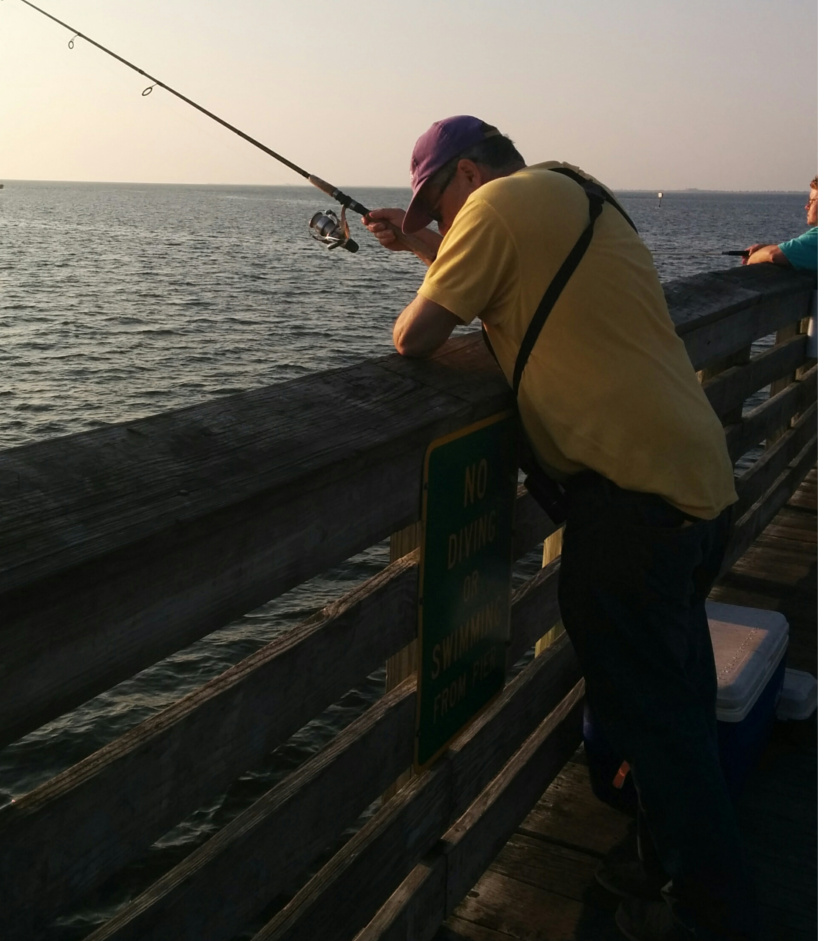
 Further to the attempt to feed my self from the wilds, some of you are aware of my questionable fishing ability.  This winter, I secured both a fresh water and a salt water licence.  After much deliberation, I found a convenient spot to drop a line into the Gulf of Mexico, which teams with fish of a thousands species.

Many of these species are some of the most desirable edible fish on Earth.  Unfortunately, this species, the Striped Burrfish, Chilomycterus schoepfi, is NOT one of them. This member of the Pufferfish family is not poisonous or dangerous, but I did not take a chance, borrowing gloves and pliers to ensure this individual returned to the Gulf of Mexico.  This one is as big as they get (10 inches) and those burrs do look intimidating close up!