More About Me

Allow me to introduce myself. Most of my spare time is dedicated to natural history and environmental knowledge development and communication. I hold an executive position with the Mississippi Madawaska Land Trust, Carleton, Place, Ontario, Canada. I live in Arnprior, the location of the official tallest tree in Ontario at Gillies Grove. It is a White Pine (Pinus Strobus) with a height of about 47 metres. The National Research Council of Canada has placed me on their Animal Care Committee, which oversees the treatment and care of laboratory animals in human health research. I have my own blog, which captures natural history knowledge and more as I make my way through various eco-districts.

Sunday, 10 May 2015

Waccamaw and Local Wilds

March 12-16

This edition will incorporate several walks through the local small bits of nature and a more ambitious first visit to Waccamaw National Wildlife Refuge along the Great Pee Dee River.
I didn't see a lot of turtles during my March 2015 stay in South Carolina.  I found this Slider Turtle (Trachemys scripta scripta) basking at the resort on the beach just to the south of the Sands Beach resort where I stayed. There is a small river between the two resorts, giving these turtles ample habitat opportunity. This is likely a large, old female, since the carapace length is close to the 11 inch maximum. Note the dark circles on the beige plastron (the underside of the shell).  These circles are unique to this species. According to the Savannah River Ecology Laboratory at the University of Georgia, this turtle is "the most ubiquitous and conspicuous species of turtle in the southeast". Another subspecies, the Red-eared Slider (Trachemys scripta elegans) has been commonly kept as a pet, resulting in local "escapee" populations.

Entering the wildlife refuge, you can see on the sign the reason for the refuge's existence. It is home to a disjunct population of the rare Swallowtail Kite. Will the Kites return from their South American wintering sites in time for me to see one? This reserve, along the Great Pee Dee River, incorporates a great example of the southern deciduous Carolinian forest. A great diversity of massive fast-growing trees greets you, including Live Oaks covered by Spanish Moss, which, you will recall from my Florida entries, is neither Spanish, nor is it a Moss. So much for common names.
Above, one of the prevalent impressive deciduous trees leafing out in March is the Sweet Gum Tree, Liquidambar styraciflua, which has leaves shaped in a shape reminiscent of maples. They grow up to 160 feet tall, with a 5 foot trunk diameter,  and are central to southern ecology and economy.  Extra bonus: crushed leaves are delightfully fragrant.
The Great Pee Dee River in flood due to melting snows back in the Appalachians. A good look at the amazing deciduous forest which occupies the plain right down to the banks of this wildlife rich river basin.
Any South Carolina child will recognize the "gumball" above. The dried fruit of the Sweet Gum tree, These dry and harden under the trees where they litter the ground, impaling anyone silly enough to traverse a path in bare feet. This feature permits sticking to, and riding furry travelers to new destinations where seeds may find barren ground. Many local flowering plants throughout North America use this strategy to propagate.


Above and below are trumpet flowers familiar to any South Carolinian. Carolina jessamine (Gelsemium sempervirens) is South Carolina's state flower.  A harbinger of Spring, this vine is widespread.  it is also widely planted as a native garden plant, adding colour and fragrance to local gardens.  Insects and deer won't eat it. All parts of the plant are poisonous. Don 't eat any!

Early Spring in southeast North America bring splashes of red colour. You can see these brilliant reds thanks to several species of shrubs and trees. The one above is a southern Red Maple covered in red seeds. Although classified as the same species we have in the Ottawa Valley (Acer rubrum), the trees in the south have a very distinctive look with light park and very crimson flowers, seeds and leaves.
Above, some Sycamore fruit, left over from Autumn, has yet to fall.

Below, I found these Black and Yellow Mud Daubers (a very large and harmless wasp found through out Eastern North America, south of the boreal forest. The northern range limit is where I live in the Ottawa Valley) active on a bridge over a wetland in the Wildlife Refuge.  They appeared, to me, to be bigger than the 30 mms size given as average in the references. Most wasps ARE harmless to us. They are specialist, often solitary, predators of other insects and arthropods....and not aggressive to humans. Some prevalent social wasps, like Yellow Jackets and Hornets, cause people to be fearful of all wasps, which is unfortunate, as most of them are very ecologically beneficial.


Some migratory birds, like the familiar White-throated Sparrow, above,  move step-wise towards their nesting grounds. Here it is pictured feeding during its March stay in South Carolina. Perhaps I saw this same one during my May weekend at Presqu'ile Provincial Park along the Lake Ontario shore, where it stopped again on its way to a Boreal Forest nesting site. Virtually all of them nest in Canada. This is likely why its song is "O Canada Canada Canada".

Another Canadian stalwart is the Hepatica, (below) an ephemeral Spring flower at home appearing in late April. Here, it wasn't common, but I found some flowering in mid March.
Below is another flower that may be familiar to many Canadians, except for the fact that it is on a tall shrub found mostly in the Atlantic Coastal Plain: Highbush Blueberry, Vaccinium elliottii.  All of the commercial high bush blueberries are derived from this species. As it flowers in March, the fruits ripen well before our low bush varieties.


I moved on to another part of this large wildlife refuge....at Jackson Bluff, just outside of Conway, SC.  I noticed a lot of young adults in this part of the Refuge. This impressed me a lot, as fewer and fewer young North Americans take to the wilderness. As I left, the reason emerged...I had missed, when I entered, the large residences of Coastal Carolina University right next to the Refuge entrance!


This part of the Refuge is  mostly upland forest, except for an exceptional Bald Cypress swamp.  A dominant wetland species from here to Florida is the River Cane. It reminds me of Bamboo, though it doesn't get quite as large. I photographed the interpretive signs along the trail to give to you directly the knowledge the interpreters have provided.


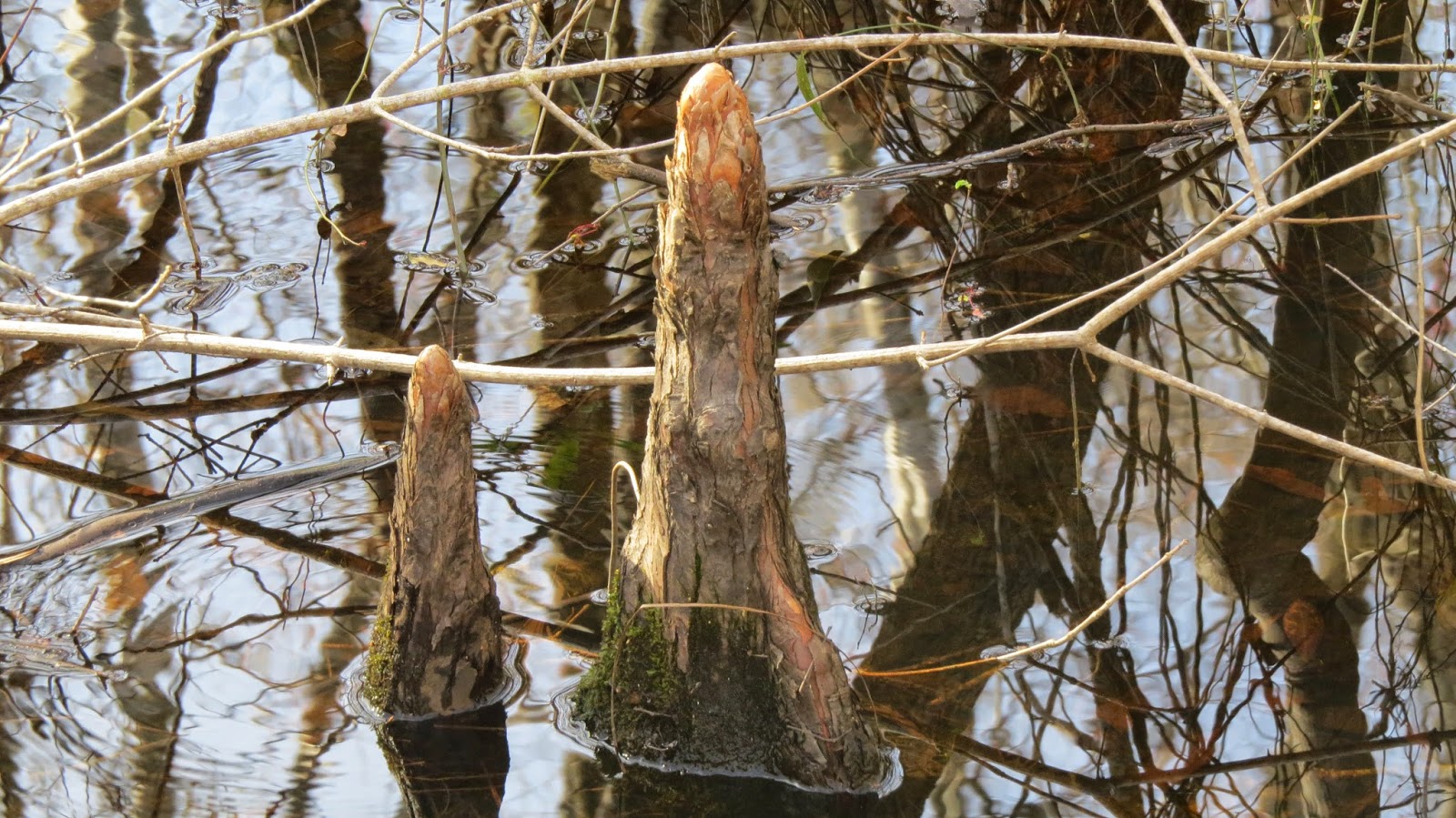
River Cane, above, and Bald Cypress "knees" below/
The boardwalk through the Bald Cypress swamp, below.

The typically widening base of a Bald Cyress tree, below.

Above, the sign provides information about Redbay, a delightful tree which was introduced to me in Florida. The fragrant leaves provide flavouring, similar to the bay leaves we use in soups and stews.


And here is a tree also found in our region, though it grows a great deal less tall back home....Red Cedar. As the sign above says, it is really a Juniper.

As the sign above tells us, the Longleaf Pine was an over harvested tree in the southeast, and Refuges are helping to recover part of this essential habitat.  I didn't find a Red-cockaded Woodpecked on this trip. I am hopeful to find one or more during a future visit. Below, is the trunk of a Longleaf. The rectangular shingles are distinctive and help to identify this tree.

Wednesday, 25 March 2015


March 17, 2015 Huntington Beach State Park. 2-6 PM Sunny 30C

A day when strong winds were in a birder's favour. The Wilson's Plover was sitting on Asphalt, warming itself, and really didn't want to move. The Seaside/Nelsons/Saltmarsh Sparrows were still uncooperative notwithstanding pishing and squeaking. The Ipswich was in the same location....and was quite happy hopping onto the boulders which make up the long jetty.  Strangely, the male Common Yellowthroat was also hunting amongst these large boulders. NO tree or shrub within half a kilometre! In the last few days, migrants (including Ontarians escaping winter) are showing up in numbers.
 This tall channel marker announces the opening of the channel to one of the few harbours on this part of the Carolina coast, Murrells Inlet.  Double Crested Cormorants find this an excellent resting place.  The jetties protect the channel, and also create a fine biological island, filled with life, especially on the tides.  Large schools of small fish, and their planktonic prey, occupy the channel with many diving birds, dolphins, and some larger fish.  The jetties also form the northern boundary to Huntington Beach State Park.  The southernmost jetty is in the park, and is topped with asphalt.
 An eager fisher admitted it was a bit early to catch anything in this cold water (the Gulf Stream is still miles offshore), but he had to get fishing in this unseasonably warm weather.
 The Wilson's Plover, below, felt the same, as it flew onto the warm asphalt while I sat.  This is the very first Wilson's Plover I have seen. This rare bird (only 10,000 remain) nests here and along the beaches of the Carolinas. It winters in south Florida, the Caribbean and northern South America.  This one had just arrived from the southern wintering area.
 And below (2 photos) is the Ipswich form of the Savannah Sparrow.  This light form is eastern, and less common than the darker form.  I went looking again for the rarer sparrows of the salt marshes just beyond the jetty: Salt Marsh, Henslow, Seaside and Nelson's.  These shy and "hard-to-see" sparrows are difficult to photograph, a real challenge. So far, I have only managed to find their much more common and less shy Savannah Sparrow cousins. Another rare sparrow occurs inland here in the Longleaf Pines: Bachman's Sparrow.  I am intending to visit Waccamaw National Wildlife Refuge in the next few days to see if any Bachman's and Swallow-tailed Kites are there.

 The brackish pools hosted a few Red-breasted Mergansers, taking a warm, sunny break from fishing.

Saturday, 21 March 2015

The Return of the Alien

Don't get excited....anyone from outside the USA is an ALIEN here. That includes me. I visited here in February, 2014.  And I returned on.....

March 11, 2015 2:30-6:00 PM Huntington Beach State Park (Murrells Inlet, South Carolina).

Sunny, some fog,  light breezes with stronger gusts, 21C.


On the causeway, which brings people out to the island on which is the majority of the state park,  people have an excellent view on both sides of the lagoon between mainland and island.  The salt marshes and ponds usually host a good variety of waterfowl, wading birds and shore birds.

I didn't expect the above bird, from features and shape, waterfowl.  It is usually found out on the ocean or in the Great Lakes, not feeding inshore with Lesser Scaup and Ruddy Ducks, The lack of markings did baffle me, though I did conclude it was one of two species of sea ducks called Scoters. My friend Jon confirmed it is a female White-winged Scoter with no white!  There is another smaller Scoter called a Black Scoter, and a third called Surf Scoter. Many Scoters swam on this day out in the ocean beyond the beaches.  This one decided to take a break. Lucky for me.  We usually do not get this close to them.

After conferring with the Park Naturalists and Rangers, I walked the 1.5 miles along the beach to the jetty at the far north end of the Park.  I was told this stretch hosts nests of two rare
plovers, Piping Plovers and Wilson's Plovers.  The latter hadn't been seen yet, but two of the former overwintered.  Nesting begins in the third week of March, so this was a good opportunity to see them in advance of nesting. The Rangers put up barriers around the nesting areas beginning on March 15, and patrol regularly after that.
On the walk out to the jetty (which marks the channel into Murrells Inlet), I found the usual Laughing Gulls, Bonaparte's Gulls and Forster's Terns, pictured above and below.
 
 
Not only do the Forster's Terns and Bonaparte's Gulls hang out together as shown above, but they also fish together, as shown below. I initially assumed this flock of hunting birds was made up of only terns, but it "terned out" that Bonaparte's Gulls and Forster's Terns have identical prey and hunting methods, and are hard to identify when they are mixed. The photo below shows three terns diving in concert with a Bonparte's Gull, the bird closest to the bottom.
 

Not too far down the beach I was honoured by the presence of one of the two overwintering Piping Plovers.  I sat down on the beach and the bird continued to hunt for food, coming closer to me.
The rounded features, and tiny black-tipped bill make this Plover by far the cutest of the Plovers! And one of the rarest, due to human pressure on their beach habitat, dogs, and ATVs.

I didn't expect to find a Giant Water Bug or Beetle in this salt water habitat.  most are 100% freshwater creatures. We all know the Giant Water Bug, a very large 5 cm. insect found in freshwater ponds. The one pictured above is a Coleoptera, a beetle, not a true bug.  And, one species of Giant Green Water Beetles, Dytiscus marginicollis, is found in salt water, on the Pacific Coast!

After some painstaking research, it appears that this 30 mm adult is a Predaceous Diving Beetle,  Cybister fimbriolatus, which has a large range, from Florida into Canada. I could find no reference which includes these beetles as marine predators.
There were many (I counted ten in one small area) of these familiar birds in the surf near the jetty. It doesn't look familiar?  That's because during their winter ocean visits, much like other Canadians, they change their plumage! Or, rather, their plumage changes.  This is a Common Loon.
Busycotypus canaliculatus (Channeled Whelk), the most common of the 4 Whelk species of Gastropods in South Carolina
Having decided to get deeper into the creatures found alive and dead on South Carolina's beaches, I obtained a copy of the:

SOuTH CAROlINA BEACHCOMBER’S GuIDE
A Guide to the Common Invertebrates,

Plants and Natural Artifacts of the South

Carolina Seashore
by
 
Susan T. DeVictor

David M. Knott

Stacie E. Crowe
 
I highly recommend this publication.
Using "The South Carolina Beachcomber's Guide, I found that the crab pictured above is a Mottled Purse Crab, Persephona mediterranea. The carapace measures up to 2.5 inches (close to this one). This is not a "beach crab". It lives in the salt water up to a depth of 55 metres.

More to come....family wants to walk on the beach at 9:30 PM.  NO winter here......

Tuesday, 10 March 2015

Bewitched, Begulled and Bewildered 2


On Wednesday March 4, 2015, I went for two walks along the beach.  I went south in the morning up to a small stream that runs into the ocean. The river stirs up the sand, making this a great place for gulls and shore birds to feed.  A dense fog permitted me to approach the birds without disturbing them.  It also made for photos that aren't quite as sharp as others taken on cloudy days.
 
I came across a very large number of gulls, including about 50 Bonaparte Gulls, pictured below. I think this may be the first time I have seen their legs! Lovely.
 
 
Clustered nearby, a large number of Laughing Gulls.
These two Bonapartes Gulls were stepping out together (below).
Grounded by the fog, as well, was a Forster's Tern (below), being reflective.

 
The afternoon walk yielded a flock of Willets (above), scouring the water for crustaceans.


The day ended, and the moon rose over the Atlantic, giving a very picturesque view through the waning fog.

The next day was warm and sunny. Walking north, I found the gulls again. The one below was getting quite bored with me.

Herring Gull

This Great Black-backed Gull seemed very nonchalant about my presence.

Cool photo above: as explained in the first part of the Myrtle Beach blog posting, there are 3 large gull species on the beach, and a mix of juveniles and adults.  Here are all three, from left: Adult Great Black-Backed, juvenile Herring and  adult Ring-billed. The size differences can be seen, largest to smallest. Great Black-backed Gulls are BIG. 

I was seeing a few Grebes, Cormorants, Loons and Mergansers in the surf.  The choppy seas didn't permit photos.  While looking out at these fishing birds, I saw the first Pelagic bird of this trip, a Northern Gannet flying from North to South without diving.

At 4:30 PM, the last strong cold front of the winter charged across the beach and out to see, where I snapped these photos of it.  The temperature plunged 20 degrees in 20 minutes, and didn't recover until Saturday, two days later.  That day I went to Huntington Beach State Park, which will be featured in the next posting.