More About Me

Allow me to introduce myself. Most of my spare time is dedicated to natural history and environmental knowledge development and communication. I hold an executive position with the Mississippi Madawaska Land Trust, Carleton, Place, Ontario, Canada. I live in Arnprior, the location of the official tallest tree in Ontario at Gillies Grove. It is a White Pine (Pinus Strobus) with a height of about 47 metres. The National Research Council of Canada has placed me on their Animal Care Committee, which oversees the treatment and care of laboratory animals in human health research. I have my own blog, which captures natural history knowledge and more as I make my way through various eco-districts.

Tuesday, March 10, 2015

Bewitched, Begulled and Bewildered 2


On Wednesday March 4, 2015, I went for two walks along the beach.  I went south in the morning up to a small stream that runs into the ocean. The river stirs up the sand, making this a great place for gulls and shore birds to feed.  A dense fog permitted me to approach the birds without disturbing them.  It also made for photos that aren't quite as sharp as others taken on cloudy days.
 
I came across a very large number of gulls, including about 50 Bonaparte Gulls, pictured below. I think this may be the first time I have seen their legs! Lovely.
 
 
Clustered nearby, a large number of Laughing Gulls.
These two Bonapartes Gulls were stepping out together (below).
Grounded by the fog, as well, was a Forster's Tern (below), being reflective.

 
The afternoon walk yielded a flock of Willets (above), scouring the water for crustaceans.


The day ended, and the moon rose over the Atlantic, giving a very picturesque view through the waning fog.

The next day was warm and sunny. Walking north, I found the gulls again. The one below was getting quite bored with me.

Herring Gull

This Great Black-backed Gull seemed very nonchalant about my presence.

Cool photo above: as explained in the first part of the Myrtle Beach blog posting, there are 3 large gull species on the beach, and a mix of juveniles and adults.  Here are all three, from left: Adult Great Black-Backed, juvenile Herring and  adult Ring-billed. The size differences can be seen, largest to smallest. Great Black-backed Gulls are BIG. 

I was seeing a few Grebes, Cormorants, Loons and Mergansers in the surf.  The choppy seas didn't permit photos.  While looking out at these fishing birds, I saw the first Pelagic bird of this trip, a Northern Gannet flying from North to South without diving.

At 4:30 PM, the last strong cold front of the winter charged across the beach and out to see, where I snapped these photos of it.  The temperature plunged 20 degrees in 20 minutes, and didn't recover until Saturday, two days later.  That day I went to Huntington Beach State Park, which will be featured in the next posting.


Monday, March 9, 2015

Bewitched, Begulled and Bewildered

Life's a beach.  North Myrtle Beach, South Carolina. I arrived on Sunday afternoon.  Good beach avifauna discovery days Monday and today (notwithstanding foggggg).

Monday, sunny, calm and 16C (good for spotting surf diving birds).  Today, foggy with afternoon sun and 20C,  Windy , making the surf too rough for most surf-diving birds. 

Large numbers of gulls winter here, and some of those that winter further south have started to arrive in numbers.  This results in some crowding on the beaches (gulls instead of "snowbirds"..how gulling!).

The following view from my 11th floor balcony gives some idea of the concentration of gulls.


Note that they are mostly facing south. The wind today was blowing from the south.  There are at least 4 species of gulls in this photo.  Although they are clustered, there are distinct groups which do not mix much.  Closest to the surf on the right are Great Black-backed Gulls, and Herring Gulls. The smaller black gulls standing close together on the left centre are Laughing Gulls.  At the bottom right are the Ring-billed Gulls, our most common gull back in the Great Lakes-St. Lawrence area, often found in fast food parking lots.  I believe it is telling that they are the gulls farthest from the sea! Another view of some of the same birds below.

 
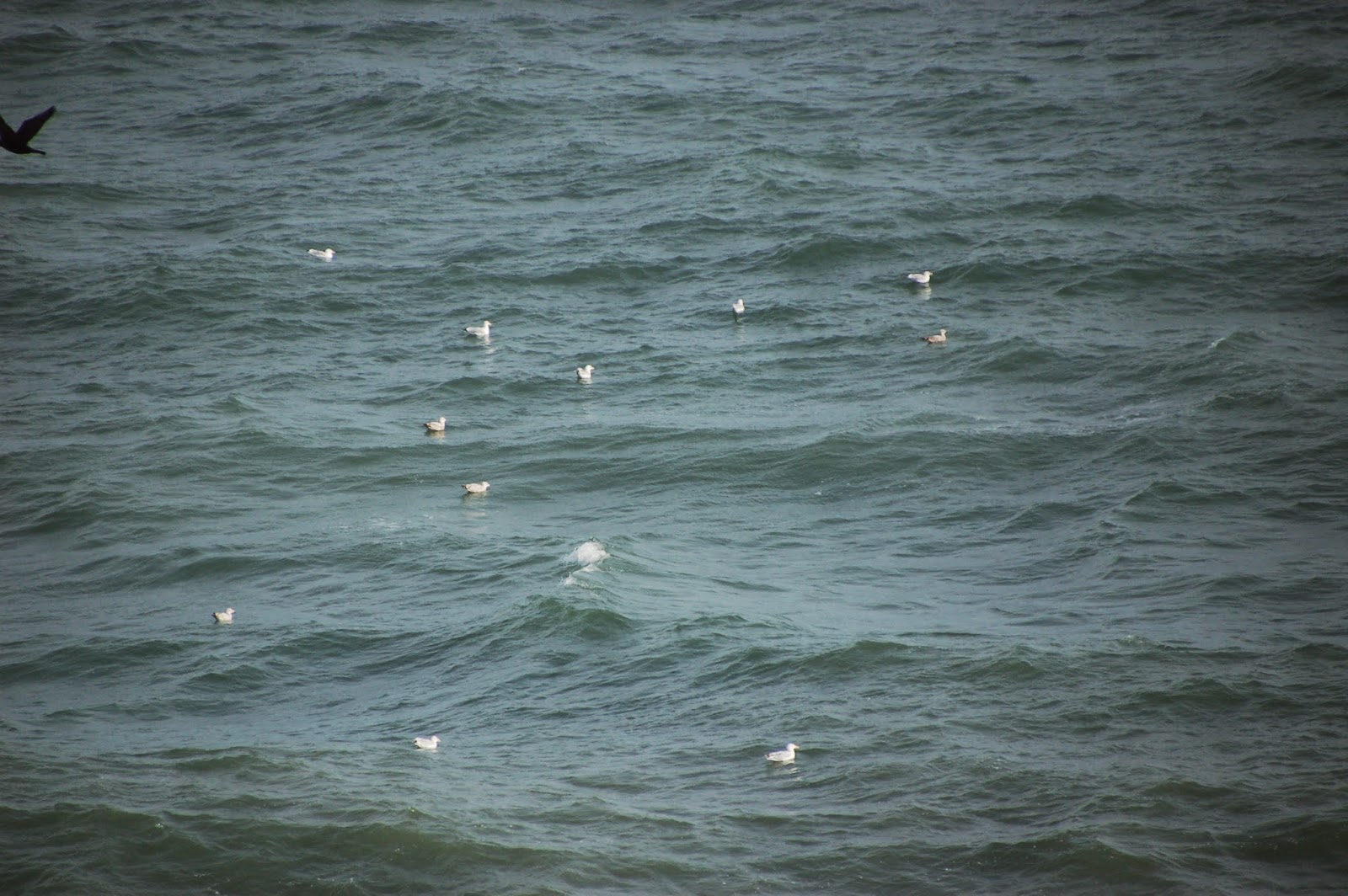
As many gulls were bobbing in the waves.


When I set out in the dense fog this morning(Wednesday), there were clusters of gulls feeding around a freshwater stream meandering through the beach into the surf.  The fast water stirs up a lot of small crustaceans for the birds. On my first walk, on Monday, I observed several of the gulls, in fact all the larger species (Great Black-backed, Ring-billed and Herring), feeding by stirring up the sand at the margin of the surf.  They would do this by "running on the spot", fast motion alternative foot stepping, which is equivalent to the probing of long bills by shore birds.  The result is freeing up some tasty small crustaceans and other small animals.  It is good seeing our "garbage dump" gulls reverting to more natural feeding practices.


By Wednesday, another gull species, absent on Monday, was on the beach in numbers: Laughing Gulls in full breeding plumage.

 
The view from the condo includes this long fishing pier.  There aren't a lot of fish near shore, as the seasonal shifting of the Gulf Stream draws the fish out between 15-20 miles offshore.  Small fish still abound, giving the seasonal diving migrants lots to chew on.

 
The view from under the pier gives a most interesting perspective.

 One of the diving, fish-eating migrants, is the red-breasted Merganser.  Here, a pair talk about their future northern trip, and plans for decorating the nest.
 The male, having enough of that conversation, shows off his stuff,  hoping for admiring glances.
 
Meanwhile, a first year Ring-billed Gull preens, in preparation to a trip back to northern McDonald's parking lots, while one of his adult brethren (below) does the fast stepping dance to stir up some tasty crustaceans.

Identification of 1st and 2nd winter gulls is challenging. Some adult gulls also look very similar.  Therefore, this is an area of nature ID that does create some confusion and consternation. Speaking of Terns....more about them later.  Above, a young, first winter Great Black-backed Gull and below,  a 2nd winter Herring Gull.  It was a little easier on this day, because there were adults with the juveniles. Note the all black bill on the bird above.

The boat-tailed grackles males, such as the one above, are a loud, large coastal resident.  There aren't many here. This one hangs around at the fishing pier. Also, the local harbinger of spring, the Northern Mockingbird, was singing constantly on the pier.
The birds below leave our area during winter, but they are present here all year long[Turkey Vultures on the wing.
 
I have been seeing many of these birds in the surf (6 this morning again, March 9).  One can easily ID it as a Grebe, but which one. There are 3 that look similar: Horned, Eared and Red-necked.  All three may occur here. The Horned Grebe is the most common.  This view is a bit fuzzy.
The view below ( a view in one can find of all 3 Grebes in Sibley), had me guessing WRONG.
Then I got a good close profile (below) of a Horned Grebe. I also spotted several Common Loons, but they were too far off shore for a good photo.  I could see 3 from my Balcony this morning, and tried to photograph them again.  I will keep on trying.  Our Common Loons spend the winter all along the southeast coast.  And they look so different form the loons we know on our summer lakes.

 More juvenile gulls. Which species?  Note the one on the left is "fast stepping" to stir up crustaceans.  No garbage or French fries for these gulls.
 
 Another small species of Gull, and I have seen many dozens of them here.  They feed out on the salt water, and do not beg food on the beach.  These are prairie Gulls called Bonaparte Gulls.
 

An adult Herring Gull above.  And, several Sanderlings, such as the one below, were also chasing crustaceans in the surf.


Looking out in the Ocean, you can see a lot of black dots, mostly diving birds of various species.  We lots of the ones above around the Ottawa River Double-crested Cormorant.  And there are several Brown Pelicans, such as the one below, nesting on a pond up the coast and feeding well to the south.  The one below was returning to the nesting site.


There aren't enough wilderness preserves along the coast here.  I visited one last year, Huntington Beach State Park.  I visited again on March 8 this year, with decent results.  I also plan to visit bird Island, at the North Carolina side of the North-South Carolina State Line.  There is also another small State Park on the coast called Myrtle Beach State Park.  It is mostly beach, but it does have a few trails I plan to visit.


Tuesday, February 3, 2015

Sandhills of Eastern Ontario

 
The Sandhills (Sand Hills) of Eastern Ontario, located in Constance Bay , along the Ottawa River just to the West of the urban Ottawa area, are remnants of sand dunes left by the glacier-Champlain Sea-river dune building processes.  There were many of these sandy areas in this region. Since they are a developers' dream, most (90% or more are gone) have been lost to subdivisions and parking lots. They are very reminiscent of the dunes in eastern Nova Scotia (still mainly intact!) and south east Florida, most of which are also now lost to development. The Constance Bay hills are a large area that was mistakenly forested by the provincial forestry department back in the post World War 2 period. Researchers have since identified this ecosystem as threatened and containing a large list of rare endemic species, both flora and fauna.
 
On Sunday September 14th, 2014, I led a group of enthusiasts through some of the trails in the Torbolton Forests (ironic official name of the protected part of the Sandhills). Although quite cool and cloudy, the group learned about the ecological history, some of the less common and rarer plants, and visited the 1 hectare clearing where the Ontario Ministry of Natural Resources established a Savannah Restoration in the late 1980's. You can read Paul Catling's (with B. Kostiuk) excellent review of this restoration project here:


Before setting out on the Sunday, Owen, Hank and I explored the trails in preparation.  We could imagine the Champlain Sea, filled with familiar marine creatures, now no closer than Riviere Du Loup Quebec, over the sandy bottom. We could also imagine the glacier meltwater crashing by us, several thousand years earlier, depositing the fine grained white sand, which had been blasted and ground from constituent rock by the massive glaciers. And also the Sea receded, the much larger "proto" Ottawa River and winds shaping the sand, forming the present day hills.

White Baneberry fruit, or Dolls' Eyes, the latter name due to the look of the fruit, 
Actaea pachypoda
This photo was taken at Gillies Grove. The plant is found in rich woods throughout our area, including the Sand Hills.  The Sand Hills were not historically rich woods, but rather a sandy, poor nutrient Savannah habitat, which means scattered trees dominated by ground vegetation, primarily grasses and sedges. Some of the rarest endemic plants here are Sedges.

 
This Goldenrod, a familiar group of plants to all of us, is a common one. The Sand Hills support one rarer species. We believed that the above plant could be one of these, Stout Goldenrod, Solidago squarrosa.
 
It isn't. It is Gray Goldenrod, S.nemoralis
 
It is a much more common, late blooming Goldenrod:
 Local people may review the entire list and the ecological history of these sand hills. David White produced one comprehensive publication on behalf of thwoe City of Ottawa (managers of the Torbolton Forest, the irony of this name may be apparent after reading about the history of the hills!):
 
 
My partner surveyor,  Owen, took the two photos below of another Goldenrod. That is Owen's hand and my feet.  This plant looked much more like the uncommon Stout Goldenrod.  It isn't!
Two strikes.  We decided to survey again next summer. Something to look forward to.
 
The Goldenrod in the photos below is another common one, Hairy (it sure is!) Goldenrod, Solidago hispida
 
 
Greg reminded me that the genus Solidago is often very difficult to identify to the species level.  There are two reasons for this. One:  individuals may vary greatly due to damage or to poor growing conditions. Two: species often hybridize, resulting in mixed characteristics.  Botanists have listed several hybrids in Ontario and conclude that many more are likely.
 
 
In late December, in support of the local Biothon, Owen returned to the Sandhills. Close to the Community Centre, he found a shrub I usually overlook. I am adding it here as a reminder to find it in the Spring when leaves are out.  its bud are similar to Sugar Maple, making this identification that much more difficult in Winter:
 
Owen's hand and Gray Dogwood, Cornus racemosa


The photos above and below are a reminder to readers to mind their fungi. As previously discussed, this biologist doesn't eat wild mushrooms.  I have been with several very highly skilled mycologists this year, who also do not ever eat wild mushrooms.  Even some common edibles, like giant puffballs, may cause gastric distress in some people (like ME!).  Identification is often difficult. Experts will not identify a mushroom from photos.  There are far too many mushrooms which look similar to each other and mushrooms change greatly in appearance with geography, climate and age.  Be cautious.  
 
I could not identify the mushroom above, however Greg Lutick, who took a similar photo of this same mushroom, with the same slug at the base, identified this as Boletus edulis.  
 
The mushroom below is Galerina autumnalis, otherwise known as Deadly Galerina.  This common, small,  unassuming mushroom grows in clusters on decaying wood, though in this case, and often, the wood is on the ground , and so decayed that it is hidden by mosses and compost.  The toxin in Galerina autumnalis is the same as the toxins contained in the deadly Amanita species (Destroying Angels). Even a small amount may prove deadly.

We made a special trip to view and photograph this lovely shrub above.  it is one of the many Viburnums that populate our woodlands: Wild Raisin, Viburnum nudum var. cassinoides (Viburnum cassinoides). Found through out the eastern part of our continent, this shrub becomes more common as one goes from south to north. We use one of this plants close relatives, Highbush Cranberry, Viburnum trilobum, for local landscaping.  I am hoping to find this one too, for planting in my new garden in the spring (attracts birds, butterflies).
 
This lovely woodland flower above is in fruit (mid-September). It is one of our yellow woodland lilies, Indian Cucumber Root, Medeola virginiana. The whorled leaves are very distinctive as is the blue-black triple fruit. Note the "pine-like" stems at the top of the photo.  This is one of the Lycopodium, or Ground Pine. It is more closely related to the ferns, as it reproduces via spores. it is in one of the broad grouping of plants called the "fern allies".

 
The Three Botanists: Owen Clarkin, Greg Lutick, and Ken Spicer. What do you think about a movie about these three in the style of The Three Amigos?


Photo above of the whole intrepid group, the author, in the front, a thorn between roses.

We enjoyed lunch at the clearing created by the Ministry of Natural Resources to re-establish native Savanna species in the Sandhills. This is the clearing referenced in the article above (Catling, Kostiuk).
 
Hank Jones accompanied us with his two delightful granddaughters, Amber and Alyssa. They are showing us the trail origin and the array of wildflowers still available for creating lovely bouquets in September.


The kids will end this, with their enthusiasm our hope for the future.  We will see you next time.