More About Me

Allow me to introduce myself. Most of my spare time is dedicated to natural history and environmental knowledge development and communication. I hold an executive position with the Mississippi Madawaska Land Trust, Carleton, Place, Ontario, Canada. I live in Arnprior, the location of the official tallest tree in Ontario at Gillies Grove. It is a White Pine (Pinus Strobus) with a height of about 47 metres. The National Research Council of Canada has placed me on their Animal Care Committee, which oversees the treatment and care of laboratory animals in human health research. I have my own blog, which captures natural history knowledge and more as I make my way through various eco-districts.

Monday, May 5, 2014

Ephemeral Early Spring

April in the Ottawa Valley, 2014. Mostly cooler than average, with lots of clouds and wind.


Yet, dear readers, nature is well adapted to these conditions and has proceeded.  I have captured a few winks and blinks of the passage of time.  The photos are all taken in the last week of April.


Things move very fast during Spring.  The snow melted slowly, thanks to the cool weather, which limited local flooding.  Though the land is still saturated, there is a lot of growing going on in the forest. Taking advantage of the short period of time between snow melt and leafing out of deciduous trees,  many forest floor plants leap into leaf and flower.  As a group, these plants are called Ephemerals. Along with a few local butterflies, moths and insects that overwinter as adults, and very early migratory birds which join their resident alumnae, the forests and other ecosystems emerge from winter.


The ephemeral ponds and marshes are wild with amphibian activity as western chorus frogs, spring peepers and wood frogs join leopard frogs, and salamanders for very intense breeding activity announced through continuous vocalisations.


In this part of the world, frost is a threat right up to the third week of May.  The plants that emerge in April are very frost tolerant.  These hardy plants cover the forest floor. Depending on the soils, aspect and geology, different plants tend to dominate.


Some of them, as with  later Spring and Summer plants, are aliens, and can be invasive.  Although
Coltsfoot,  Tussilago farfara, is an alien and can be invasive in other parts of Ontario, in this region, it isn't seen very often in the forest:


The flowers emerge from a rhizome before the leaves emerge.  Early pollinators are eager to aid in its reproduction.

Note the leafess rhizome.  To the right of the Coltsfoot is a single leaf of the Trout Lily another yellow flower which will grace our forests early in May.
Also at Beryl Gaffney Park, in south Ottawa, along the Rideau River, an Eastern Comma Butterfly flies after a long winter, and just down the path, we spy a Cecropia Moth cocoon.
Eastern Comma (photo courtesy of Jon Ruddy)

Cecropia Moth cocoon with Jon Ruddy's hand

The day after, I ventured from home to the March Highlands, which, with its marble-sandstone geology, provides a variety of interesting habitats which in turn, yield a diversity of soil types and plants.


In one area, a large number of Bloodroot, Sanguinaria canadensis L. emerges. These lovely flowers are found in much of North America (different varieties). Some have been cultivated as most desirable garden flowers. They are members of the Papaveraceae (Poppy Family).

In parts of the path, Hepatica make an appearance.  These flowers, named for the liver lobe leaves, come in a variety of pastel colours, carpeting the early spring forest floor. I like observing them from their forest floor perspective:


Hepatica leaves


Polypodium virginianum
The above fern, Polypody, is one heck of a tough customer.  Surviving the harsh winter, and ready to photosynthesize on the earliest Spring days, this fern often grows on rocks as far as our Arctic and Greenland.  Don't look for it in Florida!


And no story of wild Spring flowers in our area would be complete without Ontario's provincial flower, once classified in the Lily family (now in a separate family: Melanthiaceae) , the Trillium, which looks like this in late April. Look for the common white trilliums, "double" trilliums, and red trilliums (which are known to flower somewhat earlier then the white trillium):


Closed up, due to a cloudy day, the Spring Beauty still manages to charm.  There are Spring Beauties throughout the temperate forests of eastern North America.  They were a staple food food source to First Nations, both corms and vegetative parts.  I haven't tasted them...yet.  I prefer doing more research before trusting online sources!  These plants are probably Claytonia caroliniana, which has a broader leaf than its close relative Claytonia virginica. This is an excellent native flower for your perennial garden.

Jon was set to leave last week to BC to study Yellow-breasted Chats for the summer (some people are charmed!) for the Canadian Wildlife Service (yes they still exist FOR NOW). We managed to snag the brightest, warmest day of April (Monday the 28th) to take part in his Hawk Watch,  which is a North American effort to track and count our raptors during migration.  The largest and longest distance group of raptor migrants are the Broadwing Hawks.  On Sunday, 2800 were counted passing Derby Hill, NY on their way to our Boreal Forest (they winter in South America!).  We were lucky enough to see 7, as they rocketed past at a very high level...making observation difficult. They took advantage of an upper level strong southern airflow, minimizing their use of energy to attain very fast speeds.   While searching the clear skies, we saw another raptor, larger, moving along the same path. This one was exciting: a juvenile Golden Eagle, our largest and most majestic raptor.   
Golden Eagle

Chickadee (also known to eat FLESH)

I am travelling this week to the Prince Edward Point bird banding station and then to Prequ'ile Provincial Park.  Expect a full report soon!

Monday, April 14, 2014

Sap, Syrup and Sun

Monday March 31, Sunny 10 C


One of the warmer days of March; finally the sap flow was excellent today.  I made arrangements with friend, Steve, to help collect the sap at 5 PM. Before that event, we drove to Arnprior, Ontario where our Club,  The Macnamara Field Naturalists' Club, maintains a trail at the Nopiming Game Preserve. This lovely trail begins at McNab St. in Arnprior and wends its way through 4 kilometres of multiple habitats, and also includes a spur which goes down to the Ottawa River at Marshall's Bay.  The Club is planning an extension across the Bay, back to the kiosk at McNab St.  More about the trail and (eventually...keep on returning to find out more) our plans to extend it may be found here:
http://mfnc.ca/macnamaratrail.html

We haven't seen this level of snow pack at the end of March in several decades.  A long cold winter is hard on much wildlife, birds included.  If you begin feeding birds, they become dependent.  So be sure to continue feeding until their natural food sources are once again available.

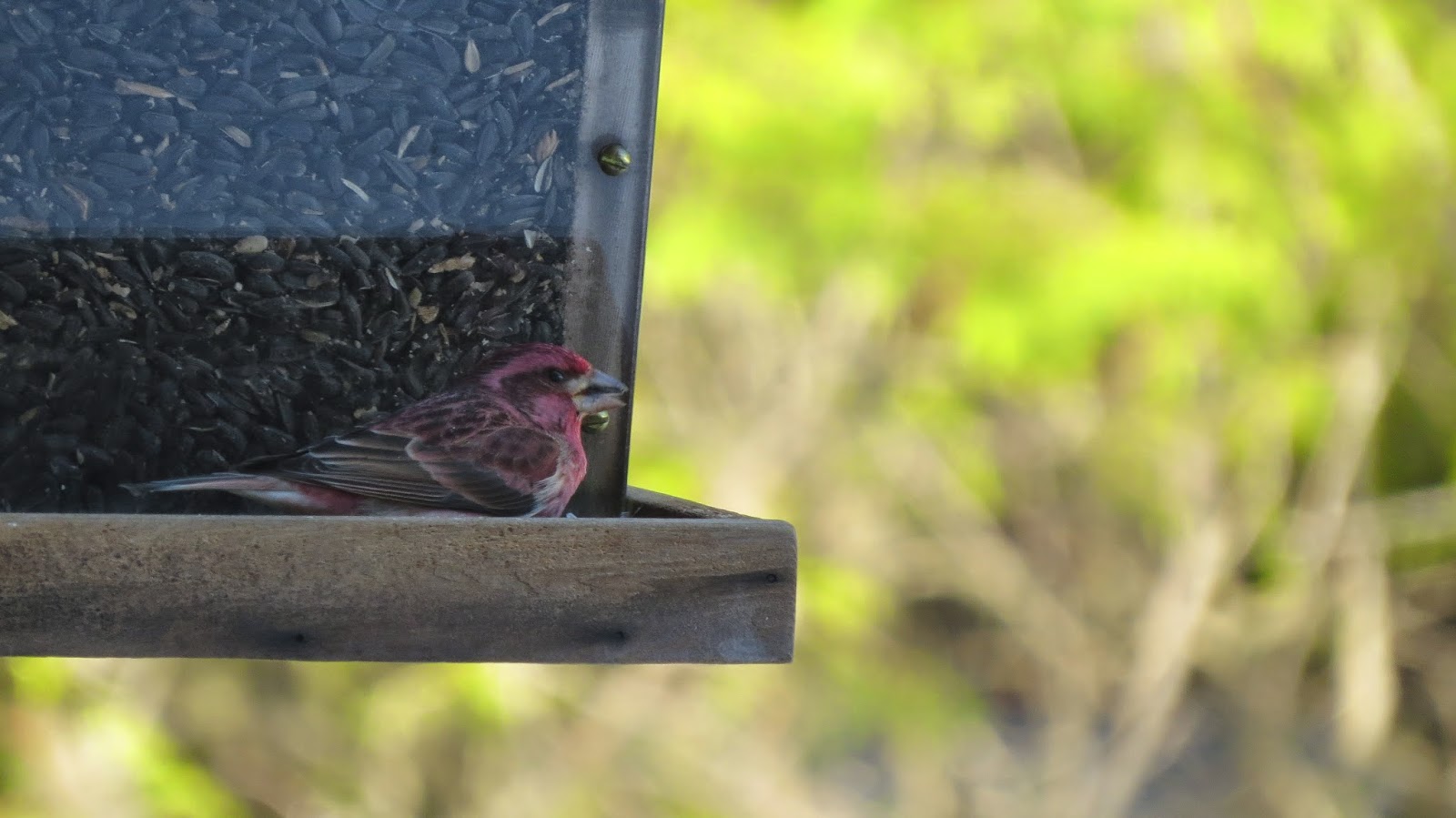
Here you can see Steve filling the feeders on the trail.  Large flocks of Purple Finches, Goldfinches, Black-capped Chickadees and Woodpeckers (which along with Nuthatches prefer suet over oil seeds or Nyjer seed). Steve has filled these feeders with much more seed than in other recent years.

Chickadee Awaits

Female Hairy Woodpecker takes a break from the nearby suet

We then made our way to the Sugar Maples, where Bob, David and Bruce joined Steve, Joan and me to collect about 35 gallons of sap (which yields about 0.9 gallons of syrup when boiled down). As we entered the maple bush, I noticed a Barred Owl swooping down onto an unseen rodent (unsuccessfully).  You can see the owl checking out movement in the snow, and some seconds afterwards, it swooped down again. Yes Barred Owls will hunt in the afternoon, especially with increased food requirements, as we enter their breeding season.
The team collects sap

Barred Owl ignores us, as a snowbound rodent captures interest

Sap bucket
The sled makes hauling manageable


Steve works and smiles for the camera


Steve collects sap in traditional pails hanging on spiles drilled by hand into maple trees, about 4-5 feet above the ground.  He uses a sled to drag full buckets back to truck he uses to bring the containers to his boiling site.


At Steve's home, many more Purple Finches have been taking advantage of the free food.


After snowshoeing through thick, deep, wet granular snow, the legs can use a few days rest!


A few days later, I visited the Remic Rapids at the Ottawa River. Rapids do not freeze, even in cold winters like this one. So waterfowl and gulls can be found here, as they return from their migration.  The Mallards may not have migrated at all, as more and more of them stay in the open water around city parks where they scrounge for food.
One of the first Canada Geese to arrive at the rapids


A Mallard drake and hen trudge through the snow beside the rapids


Common Goldeneyes only migrate as far south as they need to in order to find open water. Therefore, they usually are found throughout the Great Lakes-St. Lawrence Region during winter, even this winter!  They nest through much of Canada south of the tree line, as they prefer to nest in tree cavities.


I find it amazing how they stay warm feeding in the coldest waters where they catch invertebrates, some small fish and bits of vegetation.

A pair of Goldeneyes in the water, and a Ring-billed Gull on the ice

Migration is on and the Spring ephemeral flowers will be showing soon, so expect more from this blog shortly.


Saturday, March 8, 2014

Mom, I Am Hersty

...for more nature!


Friday, March 7th 2014. A cold (-21C) clear morning transitions into a clear sunny day, south wind, +3C. A good day to go to Lake Ontario, and check out what is migrating on those southerlies.


Amherst Island is one of several islands at the northeastern end of Lake Ontario, accessible by car ferry, at Millhaven, about 30 kms west of Kingston, ON.  It is much larger along its east-west axis than its north-south axis.  It is mostly flat to slightly rolling, and covered by farms. The entire island is a great place to find raptors.


Jon Ruddy and I made the 2.5 hour drive to the ferry terminus, arriving for the 11:30 sailing.  This ferry is a phenomenon in its own right, as it runs all winter, providing permanent residents with a reliable system for going back and forth to the mainland.  To do this, the ferry has a reinforced hull which permits it to respond like a mini icebreaker. 


The channel thus opened during this VERY cold winter, has created a small bit of open water within a very frozen large area of northeastern Lake Ontario,  I have NEVER seen the ice on Lake Ontario stretching so far from the southern shore of Amherst Island. I am told it has happened twice in the last 40 years.


A few Red-breasted Mergansers take advantage of this tiny bit of open water.

Frozen Lake Ontario, and the shoreline of Amherst Island. Note the coyote tracks.


The swirling water behind the Ferry


Note the  broken ice at each side.  Enough ice for a BIG party.


The Ferry dock, Amherst Island


One of the Red-breasted Mergansers-opportunists in the small channel opened up by the Ferry-the ONLY open water for miles around.

Jon and I begin our tour of the island, and immediately spot some Horned Larks at the side of the road. Further on, we find 6 Snow Buntings. We slip-slide to the trail, where we are set upon by a horde of evil chickadees demanding FOOD...NOW!!!


For several hours we tromp around in the snow, meeting two pairs of fellow enthusiasts, one of which tells us that a Barred Owl is nearby.  This turns out to be the ONLY owl we will find, though we spot some hawks in the fields nearby, which alleviates our sorrow and pain to some extent. We both checked myriads of Jack Pines, Cedar, Balsam Fir, Spruce and many hardwood trees up and down, looking for owl profiles and their pellets on the snow.


Jon's View

Jon

Tromping along the tail

Aren't Jack Pines photogenic?


A MOST enthusiastic Barred Owl observes the two humans


We get back to the car, gobble some lunch, adding to our growing number of raptors (4 Rough-legged Hawks and 9 Red-tailed Hawks, one of which is a very different looking northern variety).

We see a Northern Shrike, a large flock of Robins (spring!?) and Snowy Owls, 2 on the Lake Ontario ice and 5 more on various perches.  Yes, a new one day record for me, seven Snowy Owls.


We meet the returning Ferry at 5 PM for the return trip to the mainland.  Next trip, Mexico, New York for the hawk migration.
An ice mound visitor in Lake Ontario

It appears I have been spotted....

The Blogger's shadow at the stern of the Ferry

Jon says BYE BYE to Amherst Island

It appears that the residents don't want windmills!

An island farm seen from Lake Ontario


Saturday, March 1, 2014

Yikes! Shrikes!

Saturday, March 1 2014  -5C Cloudy, Windy, Some snow


Indeed, there are birds that tolerate snow. Some even migrate to our clime to spend the winter.


I offer the previous edition's Lapland Longspur, Horned Larks and Snowy Owls as examples.  Strangely, in my last two outings, I haven't seen any Snow Buntings.  These Arctic birds appear in large flocks along our roads and at our farms during winter.  Have heart though, it appears a few of these intrepid birds have found their way to Florida, with one being reported in Lee County yesterday and two in Duval County today.  Even these very hardy birds have given up this winter!


Today, with the keen eyes of Jon Ruddy, we found not one, but two Northern Shrikes not very far from my residence in Kanata (along March Valley Road, for you local people). I managed to snap a few photos of one.


On January 11 ,and January 26, I snapped photos of these birds' southern cousins in Florida: Loggerhead Shrikes.  It is interesting to compare the two, as it is rare to see both species in such a short timeframe.


Jon also spied a Rough-legged Hawk and a Snowy Owl.


After observing a host of Chickadees,  a Tree Sparrow, a Goldfinch, White-breasted Nuthatches and Mourning doves at the feeders at the west end of the Rifle Range, we then checked out the Deschenes Rapids (Ottawa River) where there were a few Goldeneyes (ducks), Mallards and even a female Bufflehead. Our last stop was the Jack Pine Trail at Moodie Drive...part of our Capital Region's Green Belt.  A nature club maintains some feeders at this trail, where a host of Downy and Hairy Woodpeckers share food with Nuthatches, Chickadees and Mourning Doves.


A few days ago, I went on snowshoes to the same spot accompanied by friends Cathy and Maureen.  We were hoping to see a Black-Backed Woodpecker....a handsome bird of our boreal forest.  We saw signs, but no bird.  To entertain ourselves, we offered some sunflower seeds to the Chickadees, with the following results.

Your Blogger with Chickadee


Downy Woodpecker at Jack Pine Trail feeder (suet)


Friend Maureen on Snowshoes on Jack Pine Trail